Understanding CAM Reconciliation: The Mechanics of Common Area Maintenance and What You Need to Know About Caps and Gross-Ups


Commercial real estate investments rely heavily on the predictable flow of net operating income. A critical component of protecting this income stream, and ensuring fair treatment of tenants, is the accurate recovery of operating expenses. Navigating the financial terms of a commercial lease goes far beyond simply agreeing on a base rent. The true financial impact of a lease agreement is often hidden within the complex clauses governing operating expenses, taxes, and insurance. These clauses often involve estimated expenses, which are projected by landlords at the start of the year and later reconciled against actual expenses at year-end. The reconciliation statement is the document that details the comparison between these estimated and actual expenses, facilitating the settlement of any differences. For property managers, landlords, and commercial tenants, understanding the granular mechanics of expense recovery is not just an accounting exercise; it is a fundamental requirement for financial viability. Ensuring each tenant pays their fair share of common area maintenance expenses is crucial for maintaining transparency and preventing disputes. Misinterpreting lease language or applying incorrect mathematical formulas can result in thousands of dollars in lost revenue for landlords or unjustified overcharges for tenants.

This comprehensive guide dissects the highly technical aspects of commercial expense recovery. We will break down the immediate answers to common questions, explore the nuanced mathematics behind expense limitations, and provide step-by-step procedures for calculating adjusted expenses in fluctuating occupancy scenarios. CAM reconciliation is important because it ensures accurate allocation of common area maintenance expenses, prevents overcharging or undercharging tenants, and helps both landlords and tenants recover or verify costs to maintain transparency and fairness. Accurate CAM reconciliations are essential for ensuring that both property owners and tenants fulfill their financial obligations fairly, as discrepancies can lead to significant financial losses and strained relationships.

Executive Summary: An Answer-First Approach

To understand the core concepts immediately, here are the foundational definitions of the mechanisms that govern commercial real estate expense recovery:

What is the basic mechanism of expense recovery?

The process of comparing estimated monthly payments made by tenants for estimated CAM charges throughout the year against the actual expenses incurred by the landlord at year-end is known as the CAM reconciliation process. These monthly payments are based on budgeted amounts, and at the end of the fiscal year, the landlord delivers a reconciliation statement typically within 30 to 90 days which details the comparison between estimated and actual expenses. If the estimated payments fall short of the actual costs, the tenant is billed for the shortfall; if the estimates exceed the actual costs, the tenant receives a credit. This final adjustment is called a “true-up,” ensuring tenants are either credited for overpayments or billed for any financial shortfalls. After receiving the reconciliation statement, tenants typically have audit rights to review the landlord’s books to verify the accuracy of the charges.

What are CAM charges?

CAM charges (Common Area Maintenance charges) are calculated based on the tenant’s proportionate share of the total square footage of the building, as specified in the lease agreement. These charges typically include property taxes, property insurance, maintenance and repairs, landscaping, snow removal, security services, and common area utilities. CAM charges can account for 20-40% of total occupancy costs, making accurate reconciliation essential to avoid significant financial discrepancies.

What is an Expense Cap?

An expense cap is a negotiated lease provision that limits the maximum percentage by which a tenant’s share of controllable operating expenses can increase from one year to the next. It protects tenants from unpredictable spikes in property management costs.

What is a Gross-Up?

A gross-up is an accounting adjustment applied to variable operating expenses. When a building is not fully occupied, a gross-up artificially inflates variable costs to simulate what the expenses would have been if the building were fully occupied (typically defined as 95% or 100%). This ensures equitable distribution of variable costs and protects both landlords and tenants in base-year lease structures.

The Strategic Importance of Expense Recovery Accuracy

The annual CAM reconciliation is often the most heavily scrutinized financial event in the landlord-tenant relationship. A poorly executed process leads to tenant disputes, delayed payments, audit demands, and eroded trust. Accurate reconciliation procedures are essential to avoid disputes and ensure fair cost distribution among tenants and property owners. Conversely, a transparent, accurate, and contractually compliant process reinforces the professionalism of the property management team and ensures that the asset performs at its highest financial potential.

The complexity of this process is driven by the fact that no two commercial leases are exactly alike. Even within the same office building or retail center, different tenants will have negotiated different exclusions, base years, proportionate share denominators, and expense limitations. Multi-tenant properties add further challenges, as each tenant’s pro rata share must be calculated precisely to ensure fair allocation of costs. Errors in calculating pro-rata shares can lead to significant discrepancies, especially in multi-tenant properties, resulting in substantial disputed charges. Errors in CAM reconciliations can have severe consequences, including financial losses due to under-recovered expenses and legal disputes with tenants over perceived overcharges. Managing this web of distinct contractual obligations requires sophisticated systems and a deep understanding of commercial real estate accounting principles. Fulfilling financial obligations fairly is crucial for both property owners and tenants.

Deep Dive: Understanding Expense Caps

Expense caps are primarily utilized to provide tenants with a degree of budgetary certainty, and are typically applied to controllable CAM expenses costs that landlords can influence or manage, such as landscaping, janitorial services, and routine maintenance. Controllable CAM expenses are distinct from non-controllable CAM expenses, which include costs outside the landlord’s influence, such as utilities and property taxes. Leases often distinguish between controllable costs, like maintenance and janitorial services, and non-controllable costs, such as taxes and insurance.

Expense limits (caps) are commonly set on controllable costs to define the maximum allowable increase that the tenant is responsible for, while non-controllable CAM expenses are generally excluded from such limits. This means that expense limits are designed to protect tenants from excessive increases in controllable costs, and any excess costs above the cap are typically covered by the landlord. Increases in controllable CAM expenses can directly affect tenants’ rent contributions, so these caps help increase tenants’ predictability of operating expenses. Non controllable CAM costs, on the other hand, are not subject to these caps due to their inherent unpredictability and the landlord’s inability to control them.

Controllable vs. Uncontrollable Expenses

The most critical step in applying any expense limitation is bifurcating the general ledger into controllable costs and non-controllable CAM expenses. Caps are almost universally applied only to controllable costs.

Non-controllable CAM expenses:

These are costs dictated by third parties or external forces that the landlord cannot influence. Examples of non-controllable CAM expenses include utilities, property taxes, and property insurance premiums, as well as snow removal (often dependent on weather severity) and utility rates set by municipalities. Landlords will rarely agree to cap these items.

Controllable costs:

These are costs where the landlord has discretion over the scope, vendor selection, and frequency of the service. Examples of controllable costs include landscaping, janitorial services, property management fees, parking lot sweeping, and preventative maintenance.

Leases often distinguish between controllable costs, such as landscaping and janitorial services, and non-controllable costs, such as taxes and insurance.

Types of Expense Limitations

Expense limits are contractual caps set on certain controllable costs within a lease, such as marketing or labor. Their purpose is to define the maximum allowable increase that the tenant is responsible for, protecting tenants from unexpected spikes in operating expenses. Any excess costs above these limits are typically covered by the landlord.

The specific mathematical application of a cap depends entirely on the qualifying language in the lease agreement. The three most common structures are:

  • Non-Cumulative Caps

A non-cumulative cap is calculated strictly on the prior year’s actual expenses. If the cap is 5%, the maximum a tenant can be charged for controllable expenses in the current year is 105% of what they were charged in the previous year. If the actual expenses in a given year drop, the ceiling for the following year drops with it. This is highly favorable to the tenant, as it helps manage the risk of increase tenants may face in their rent contributions due to rising controllable costs.

  •  Cumulative Caps

A cumulative cap allows the landlord to carry forward unused portions of the allowable increase. If a lease has a 5% cumulative cap, the landlord is entitled to a 5% increase every year over the base year, regardless of the actual expenses in the intervening years. If actual expenses only grow by 2% in year one, the landlord has banked a 3% shortfall that can be applied in future years if expenses suddenly spike. Expense limits in this structure help ensure that tenants are not subject to unpredictable increases in their share of CAM expenses.

  • Cumulative Compounding Caps

This is the most landlord-friendly variation. Not only does the allowable maximum increase build cumulatively from the base year, but the percentage is applied to the previously capped amount, allowing the maximum allowable recovery to grow exponentially over the lease term. Expense limits in this context are crucial for tenants to control their exposure to escalating costs.

Data Table: Cumulative vs. Non-Cumulative Cap Comparison

The following table demonstrates the mathematical divergence between a 5 percent non-cumulative cap and a 5 percent cumulative cap over a three-year period, assuming a base year controllable expense of $100,000.

Year

Actual Expense Non-Cumulative Maximum Allowed Cumulative Maximum Allowed

Base Year

$100,000

N/A

N/A

Year 1

$102,000

$105,000 (Based on Base)

$105,000 (Based on Base)

Year 2

$110,000

$107,100 (Based on Yr 1 Actual)

$110,250 (Based on Yr 1 Max)

Year 3 $112,000 $112,455 (Based on Yr 2 Capped)

$115,762 (Based on Yr 2 Max)

As demonstrated, the cumulative cap allows the landlord to recover the full $110,000 in Year 2 because the allowable maximum had grown to $110,250. Under the non-cumulative structure, the landlord suffers a shortfall recovery because the limit was based strictly on the unusually low actual expenses of Year 1.

Step-by-Step Procedure: Applying an Expense Cap

To ensure precise compliance with lease terms, financial analysts must follow a rigid, sequential procedure when applying caps at year-end.

  • Isolate Controllable Expenses: Review the general ledger and extract all expense categories defined by the lease as controllable.
  • Determine the Base Metric: Identify the starting figure for the calculation. For a new lease, this is the controllable expense total for the Base Year. For subsequent years, determine if the cap is cumulative or non-cumulative to identify the correct prior-year figure.
  • Calculate the Ceiling: Multiply the base metric by the negotiated percentage increase.
  • Compare Actuals to Ceiling: Compare the actual current-year controllable expenses to the calculated ceiling.
  • Apply the Limitation: If actual expenses are below the ceiling, bill the actual amount. If actual expenses exceed the ceiling, limit the tenant’s billable share to the ceiling amount.
  • Calculate Uncontrollable Share: Add the tenant’s full pro-rata share of uncontrollable expenses to the capped controllable amount to determine the final liability.

Demystifying Gross-Ups in Commercial Leases

While caps protect tenants from operational cost spikes, gross-ups exist primarily to ensure equitable cost distribution when a building experiences fluctuating occupancy. This concept is most prevalent in office buildings operating under Base Year or Modified Gross lease structures. Accurate allocation and reconciliation of expenses related to shared spaces and shared expenses is essential to ensure tenants are billed fairly and disputes are minimized.

Area maintenance CAM charges cover the costs of maintaining shared spaces such as parking lots, landscaping, and lighting. Maintaining shared spaces is crucial, and accurate gross-up calculations help ensure each tenant pays their fair share and that there is fair cost distribution among tenants.

To understand gross-ups, one must understand the fundamental flaw of a Base Year lease in a partially empty building. In a Base Year lease, the tenant is only responsible for their proportionate share of operating expenses that exceed the expenses incurred during their first year of occupancy (the Base Year).

Imagine a tenant moves into a building that is only 50 percent occupied. The cost to clean the building, remove the trash, and supply water is significantly lower than it would be if the building were full. Therefore, the tenant’s Base Year expenses are established at an artificially low level. If the landlord successfully leases the remaining 50 percent of the building in the second year, the variable expenses will double. Because the tenant’s Base Year was set so low, they will be hit with a massive increase in expense pass-throughs, simply because the building filled up.

Conversely, if the building was 100 percent full during the Base Year, but drops to 50 percent occupancy in year two, the landlord will suffer. The overall expenses will drop, the expenses will not exceed the Base Year threshold, and the landlord will be unable to recover the costs from the remaining tenants, severely impacting net operating income.

Variable vs. Fixed Expenses

To solve this inequity, accountants use a gross-up provision. However, a gross-up can only be applied to variable expenses.

Fixed Expenses:

Also known as fixed costs, these are expenses that do not vary with occupancy or usage. Fixed costs include property taxes, landscaping, exterior window washing, roof maintenance, and property insurance. Grossing up fixed costs is a critical audit violation and artificially inflates landlord recovery.

Variable Expenses:

These costs fluctuate in direct proportion to the physical occupancy of the building. The most common examples are interior janitorial services, trash removal, management fees (if tied to collected revenue), and specific utilities like water and sewer.

The Standard 95 Percent Rule

Most modern commercial leases dictate that variable expenses must be grossed up to reflect a 95 percent or 100 percent occupancy level. The 95 percent standard is widely accepted because it acknowledges that a building is rarely perfectly full due to normal tenant turnover and structural vacancy.

By grossing up the variable expenses in both the Base Year and the Comparison Year, both the landlord and the tenant are protected from wild swings in expense liability that are purely driven by occupancy changes. The gross-up normalizes the expenses, ensuring the tenant only pays for increases driven by inflation or actual operational cost increases.

Step-by-Step Procedure: Calculating a Gross-Up

Executing a gross-up requires precise accounting and a clear understanding of the building’s average annual occupancy.

  1. Determine Average Occupancy: Calculate the average physical occupancy of the building for the fiscal year. This is usually done by averaging the occupied square footage at the end of each month.
  2. Isolate Variable Expenses: Separate all variable operating expenses from fixed expenses in the general ledger.
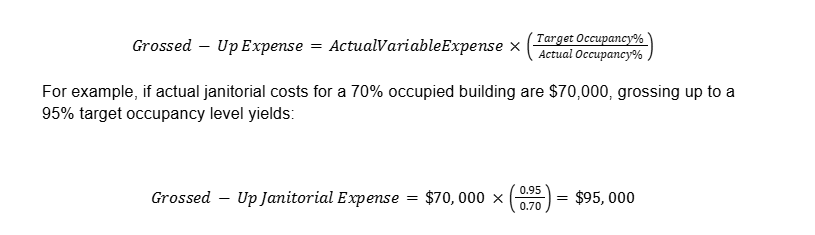
  3. Calculate the Gross-Up Factor: Divide the target occupancy (e.g., 95 percent) by the actual average occupancy.
  4. Apply the Factor: Multiply the total variable expenses by the Gross-Up Factor. This yields the Adjusted Variable Expense.
  5. Recombine Expenses: Add the Adjusted Variable Expense back to the total Fixed Expenses.
  6. Calculate Pro-Rata Share: Multiply the recombined total by the tenant’s proportionate share to determine their financial liability.

Data Table: Gross-Up Calculation Example

The following table illustrates how a gross-up normalizes expenses for a building that experienced an increase in occupancy. Assume a 100,000 square foot building. The tenant occupies 10,000 square feet (a 10% pro-rata share). The lease requires a 100% gross-up.

Metric

Base Year (50% Occupied)

Year 2 (100% Occupied)

Actual Fixed Expenses

$500,000

$500,000

Actual Variable Expenses

$100,000

$200,000

Total Actual Expenses

$600,000

$700,000

Gross-Up Factor

100% / 50% = 2.0

100% / 100% = 1.0

Adjusted Variable Exp.

$100,000 x 2.0 = $200,000

$200,000 x 1.0 = $200,000

Total Grossed-Up Pool

$500,000 + $200,000 = $700,000

$500,000 + $200,000 = $700,000

Tenant Share (10%)

$70,000 (Base Year Limit)

$70,000

Amount Billed for Increases

N/A

$0

Without the gross-up, the tenant’s Base Year pool would have been $600,000 (Share = $60,000). In Year 2, the pool would jump to $700,000 (Share = $70,000). The tenant would be billed an additional $10,000 simply because other tenants moved into the building. The gross-up process normalizes the base year to $700,000, correctly resulting in zero increase for the tenant in Year 2, as the actual operational costs remained flat relative to occupancy.

Intersecting Caps and Gross-Ups: Advanced Scenarios

The true test of a property management accounting team arises when a single lease contains both a cumulative controllable expense cap and a requirement to gross-up variable expenses to 95 percent.

In these advanced scenarios, the order of operations is vital. Financial analysts must first gross-up the relevant variable expenses based on the building’s physical occupancy. Only after the grossed-up expense pool is established can the team then bifurcate that pool into controllable and uncontrollable categories. Finally, the historical cap calculations are applied to the grossed-up, controllable portion of the expenses. The reconciliation cycle plays a crucial role here, as making precise adjustments during each period ensures accurate pro-rata shares and helps prevent calculation errors that can lead to disputed charges.

Errors in this sequence are the leading cause of audit findings. If a landlord applies a cap to raw actual expenses before applying the gross-up, the baseline for future years will be permanently miscalculated, resulting in compounding financial losses over a ten-year lease term. Therefore, it is essential to identify errors early in the process to prevent these losses and ensure compliance.

Best Practices for Standardizing the CAM Reconciliation Process, Audit, and Verification

To mitigate risk and ensure seamless tenant relations, real estate organizations must adopt standardized internal audit and reconciliation procedures to maintain transparency and accuracy in CAM charge calculations.

  1. Abstract Verification: Do not rely solely on previous year calculations. Ensure that a qualified lease administrator reviews the source lease document and any amendments to verify base years, cap types, and gross-up percentages.
  2. Expense Classification Review: Annually review the chart of accounts to ensure that general ledger coding accurately reflects the controllable versus uncontrollable definitions established in the leases. A misclassified invoice (e.g., coding a controllable interior repair as an uncontrollable capital tax expense) will bypass the negotiated cap entirely.
  3. Occupancy Tracking: Maintain rigorous, verifiable records of monthly physical occupancy, not just economic occupancy. A tenant who is paying rent but has physically vacated their suite does not consume variable resources like trash removal and water, which alters the gross-up calculation.
  4. Transparent Tenant Reporting: When delivering the final year-end billing statements, provide tenants with an itemized breakdown of shared expenses, clearly showing what costs have been paid, what has been reimbursed, and what is currently owed. Accurate documentation and transparency in reporting are essential to avoid disputes over charges and payments.

Additionally, tenants should be informed of their audit rights, which typically include the ability to review the landlord’s financial records, including those from prior years, to verify the accuracy of CAM charges. Following detailed reconciliation procedures and providing thorough documentation help foster trust and reduce the risk of conflicts.

The Role of Specialized Expertise in Real Estate Operations

The intricacies of these calculations highlight why relying on generalized accounting software or inexperienced personnel is a massive operational risk. The execution of these financial mechanics requires a dedicated focus on commercial real estate principles. Because a single error can compound over the life of a multi-year lease, ensuring accuracy is paramount.

For property owners with large, diverse portfolios spanning retail, office, and industrial assets, managing multiple properties introduces significant challenges. The sheer volume of unique lease clauses and the need for an accurate CAM reconciliation process make manual calculation virtually impossible to scale. In the broader context of commercial property investments and operations, accurate reconciliation of cam fees, cam expenses, and cam costs is essential to prevent financial discrepancies and legal disputes. This is precisely why many institutional landlords and agile property management firms turn to dedicated CAM reconciliation services. By outsourcing the heavy lifting of lease abstraction, expense classification, and complex mathematical modeling, internal asset managers can redirect their focus toward tenant retention, leasing strategy, and maximizing overall asset valuation.

Utilizing a specialized CAM reconciliation company like RE BackOffice ensures that every cumulative cap is tracked correctly year over year, every variable expense is grossed up in accordance with strict legal standards, and every tenant invoice is backed by verifiable, audit-proof data. The CAM reconciliation process involves reconciling estimated charges with actual CAM expenses and actual operating expenses to ensure accurate billing. Operating costs include a variety of expenses related to property maintenance, such as parking lots and other common areas, but capital expenditures must be correctly classified to avoid reconciliation errors. Common mistakes, such as misclassifying capital expenditures as operating costs, can invalidate the reconciliation process. It is also crucial to identify specific expenses that are included or excluded from CAM calculations, such as capital improvements, leasing commissions, legal fees, marketing costs, and owner-specific expenses, to ensure fair and accurate tenant billing. If actual expenses exceed estimated payments after reconciliation, additional payments may be required from tenants.

Managing the intricate details of commercial leases requires precision, dedicated time, and specialized expertise that often exceeds the capacity of an in-house property management team. CAM expenses are often allocated to tenants based on their proportionate share tenants based on their lease agreements and tenants are responsible for paying expenses as outlined in their leases. In some lease structures, lump sum payments may be used to cover annual CAM charges. The property owner is responsible for managing expenses, ensuring fair billing, and maintaining communication with tenants. This is where partnering with a dedicated team can transform your real estate operations. RE BackOffice provides comprehensive back-office support tailored for the real estate industry, offering meticulous lease abstraction, precise financial accounting, and expert handling of complex expense recoveries. By leveraging RE BackOffice, property managers and owners can ensure mathematical accuracy, maintain strict lease compliance, and scale their operations efficiently, allowing their core team to focus on strategic growth and tenant satisfaction rather than administrative burdens. Additionally, expanding your portfolio with a specific landlord can increase your negotiating power, potentially leading to more favorable lease terms and CAM fee structures. Accurate common area maintenance CAM reconciliation and billing are critical for maintaining financial integrity and strong landlord-tenant relationships.

RE BackOffice


How Commercial Landlords & Owners Use Standardized CAM Reconciliation to Drive NOI


In the world of commercial real estate (CRE), Net Operating Income (NOI) is the “North Star.” It dictates property valuation, influences lending terms, and determines the overall success of an investment. While most owners focus on increasing occupancy and base rent, a significant portion of potential income is often lost through inefficient expense recovery.

Standardizing your CAM reconciliation process is not just an accounting necessity; it is a powerful lever for value creation. By utilizing professional CAM reconciliation services, landlords can transform a tedious year-end chore into a precision tool for financial growth.

The Financial Impact: Why Standardization Matters

The goal of CAM reconciliation is to ensure that the landlord recovers the exact amount of operating expenses permitted under each specific lease. When this process is fragmented or manual, “revenue leakage” occurs.

Feature Fragmented/Manual Process Standardized CAM Reconciliation
Accuracy Prone to human error and missed caps. High precision through structured audit trails.
Recovery Legitimate expenses are often overlooked. Maximizes recovery of every allowable dollar.
Tenant Trust High dispute rates due to lack of clarity. Transparency reduces audits and legal friction.
Speed Takes months, delaying cash flow. Rapid execution accelerates bill-back collections.

5 Ways Standardized CAM Reconciliation Drives NOI

1. Eliminating Revenue Leakage

Revenue leakage is the silent killer of NOI. In our many years of auditing retail leases, the most common mistake we see is the failure to properly “gross up” operating expenses in partially occupied buildings. If your building is 70% occupied but you only recover 70% of variable costs (like janitorial or utilities), you are losing money. A standardized CAM reconciliation ensures these adjustments are calculated correctly, shifting the cost burden back to the tenant as permitted by the lease.

2. Strict Adherence to Expense Caps

Many modern retail and office leases include “caps” on controllable expenses (e.g., a 5% year-over-year limit on landscaping or management fees). Without professional CAM reconciliation services, it is easy to lose track of these cumulative or non-cumulative caps. Standardizing this data ensures you never inadvertently overcharge a tenant, which leads to costly audits, or undercharge them by failing to carry forward a “base year” correctly.

3. Optimized Resource Allocation

Internal accounting teams are often overwhelmed during “reconciliation season” (January through April). By outsourcing to specialized CAM reconciliation services, owners allow their internal teams to focus on high-value asset management and leasing activities. This operational efficiency indirectly boosts NOI by reducing overhead and administrative burnout.

4. Enhancing Asset Valuation

In commercial real estate, every $1 of recovered expense adds significantly to the property’s value. For example, at a 6% capitalization rate, recovering an additional $10,000 through accurate CAM reconciliation adds roughly $166,667 to the property’s market value.

5. Mitigation of Audit Risks and Legal Fees

Tenant audits are expensive and time-consuming. When a landlord provides a standardized, line-item-ready reconciliation report, it signals professional management. In our experience, tenants are significantly less likely to trigger a full-scale audit when they receive a transparent package that clearly maps General Ledger (GL) expenses to lease clauses.

Step-by-Step: The Standardized CAM Reconciliation Process

To achieve the “Experience” signal that institutional investors look for, your process must be repeatable and transparent.

  1. Data Centralization: Aggregate all GL reports, invoices, and utility bills.
  2. Lease Abstraction: Extract key recovery data (Pro-rata share, caps, base years, and exclusions).
  3. Expense Categorization: Separate “Recoverable” vs. “Non-Recoverable” (e.g., Capital Expenditures or Landlord-specific legal fees).
  4. The Calculation Phase: Apply gross-up adjustments and pro-rata shares.
  5. Quality Assurance: Cross-reference current year recoveries against historical trends to spot anomalies.
  6. Tenant Statement Distribution: Issue clear, professional bill-back or credit statements.

Common Pitfalls: Insight from the Field

Generic AI-generated advice often misses the nuances of CRE. From a boots-on-the-ground perspective, the “devil is in the details” of the lease language.

  • The “Capital Improvement” Trap: We frequently find that owners accidentally include a full roof replacement in a single year’s CAM reconciliation. Unless the lease allows for amortization, this is a surefire way to trigger a tenant dispute and lose an audit.
  • Administrative Fee Errors: Many landlords apply a 15% administrative fee to all expenses, including taxes and insurance. However, many leases explicitly exclude “non-controllable” costs from the admin fee calculation.
  • Inconsistent Pro-Rata Bases: If a tenant moves out mid-year, their pro-rata share must be weighted by days of occupancy. Manual spreadsheets often fail to capture this nuance, leading to thousands of dollars in miscalculations.

By partnering with CAM reconciliation services, landlords gain access to specialized software and experts who catch these discrepancies before they hit the tenant’s desk.

Choosing the Right CAM Reconciliation Services

When selecting a partner, look for firms that offer more than just data entry. You need a team with deep expertise in:

  • Complex Retail Anchors: Dealing with “major” vs. “minor” tenant distinctions.
  • Mixed-Use Portfolios: Allocating costs across residential, retail, and office components.
  • Year-Round Support: CAM reconciliation should be a continuous data-collection process, not a frantic April scramble.

The most successful landlords treat CAM reconciliation as a year-round discipline. By ensuring that every invoice is coded correctly the moment it arrives, the final CAM reconciliation becomes a seamless validation rather than a forensic investigation.

Why RE BackOffice is the Preferred Partner

At RE BackOffice, we understand that CAM reconciliation is the heartbeat of property profitability. With over many years of experience, we provide a level of “Experience” and “Expertise” that generic software cannot match. Our CAM reconciliation services are designed to act as an extension of your team, providing the “Authoritativeness” required to defend your recoveries during tenant audits.

We don’t just process numbers; we analyze leases to ensure every cap, exclusion, and gross-up is applied with surgical precision. By standardizing your CAM reconciliation through our proven methodology, we help you eliminate revenue leakage and maximize the value of your real estate portfolio. Whether you manage a single shopping center or a multi-national REIT, our CAM reconciliation services provide the “Trustworthiness” your tenants and your investors demand.

Conclusion

Standardizing your CAM reconciliation is one of the most effective ways to drive NOI and increase property value. By moving away from manual, error-prone spreadsheets and embracing professional CAM reconciliation services, commercial landlords can ensure financial accuracy and operational excellence.

Don’t leave your NOI to chance. Let the experts at RE BackOffice handle your CAM reconciliation so you can focus on growing your empire. Our dedicated team ensures that your CAM reconciliation is completed accurately, on time, and in full compliance with your lease agreements. With RE BackOffice providing your CAM reconciliation services, you gain a strategic partner committed to your long-term financial success. In an industry where every cent counts, a standardized CAM reconciliation is your strongest defense against profit loss and your best tool for growth. Our CAM reconciliation services at RE BackOffice empower you to take control of your expenses and maximize your returns. Trust the “Experience” of RE BackOffice for all your CAM reconciliation needs.

RE BackOffice

Stopping Overpayments: Why Specialized Lease Auditing is a Tenant’s Best Asset


Commercial real estate leases are filled with hidden financial traps that can quietly drain your company’s bottom line year after year. If your team is passively paying annual operating expense invoices without a forensic review, you are likely leaving thousands of dollars on the table. Read the full blog to discover how proactive lease auditing can immediately protect your corporate assets and recover lost revenue.

What is the Best Way to Stop Operating Expense Overpayments?

To stop operating expense overpayments immediately, tenants must transition away from passive, automatic invoice payment systems and adopt a proactive, lease-by-lease auditing protocol. The absolute most effective method for achieving this is leveraging expert CAM reconciliation services to rigorously scrutinize landlord billing statements against the highly specific legal stipulations of the original lease agreement and all subsequent amendments. Commercial leases are notoriously dense documents, and landlords or their property management teams frequently pass through non-allowable expenses due to administrative oversight or aggressive billing practices. Implementing rigorous CAM reconciliation acts as an impenetrable financial safeguard, directly ensuring that commercial tenants only pay their strictly and legally required pro-rata share of eligible operating expenses. By adopting an answer-first approach to expense management, businesses stop financial leaks before they impact quarterly earnings.

Understanding the Framework of Commercial Real Estate Leases

The foundation of any property expense dispute lies in the structure of the lease itself. In the commercial real estate sector, triple net leases are the most common structure for retail spaces, industrial warehouses, and many office buildings. Under a standard triple net lease, the tenant agrees to pay a base rent plus a proportionate share of the building’s property taxes, property insurance, and common area maintenance.

The complexity arises because common area maintenance is an umbrella term that covers a massive variety of potential costs. These can range from parking lot lighting and landscaping to security patrols and janitorial work for shared lobbies. The definition of what constitutes a valid maintenance expense versus what constitutes a capital improvement or an exclusionary cost is dictated entirely by the negotiated language within the specific lease document. Tenants who assume that all billed expenses are automatically valid are opening themselves up to significant financial risk.

The Danger of Passive Invoice Processing

Many commercial tenants, especially those experiencing rapid growth, view annual operating expense statements as fixed and uncontrollable costs. This is an incredibly costly misconception. Landlords and their third-party property management teams manage vast portfolios and handle massive amounts of financial data. Because they are human, billing errors happen constantly.

Sometimes these errors are simple mathematical mistakes, such as applying the wrong percentage to the tenant’s share. Other times, the errors are structural. A landlord might pool all expenses for a mixed-use development together, failing to carve out the specific expenses that only benefit the residential portion of the property, passing those costs down to the commercial retail tenants. Without executing precise CAM reconciliation, tenants silently absorb these inflated costs year after year. By utilizing highly dedicated CAM reconciliation services, businesses can uncover these hidden discrepancies. When a tenant blindly pays an inflated annual invoice, they permanently lose capital that should have been invested directly back into their core business operations.

Real World Lease Challenges

In our many years of auditing retail leases, the most common mistake we see is the assumption that landlord calculations are automatically correct and unquestionable. Time and time again, we review portfolios where tenants have overpaid by tens of thousands of dollars simply because capital improvements, like a brand new roof installation or a complete parking lot repaving project, were quietly billed as standard, routine repairs.

Through our extensive historical work performing CAM reconciliation, we have definitively learned that property managers frequently apply blanket expense pools across entirely diverse tenant rosters. In doing so, they completely ignore the specific legal exclusions that were carefully negotiated in individual corporate leases. This stark reality is exactly why investing in professional CAM reconciliation services consistently pays for itself. Industry experts know exactly where to look for buried capital expenses, incorrect gross leasable area denominators, and inappropriate management fee markups.

Step-by-Step Procedure: Conducting a Comprehensive Lease Audit

Conducting a truly thorough expense audit requires intense precision and an organized methodology. Here is the step-by-step procedure utilized by top-tier CAM reconciliation services to systematically identify and recover financial overpayments:

  1. Gather All Legal Documentation. Collect the fully executed original lease agreement, all subsequent amendments, letter agreements, the annual expense statement from the landlord, and the previous three years of historical expense statements for comparative analysis.
  2. Verify the Pro-Rata Share Denominator. Recalculate the gross leasable area of the tenant space and the total gross leasable area of the entire shopping center or office building. A fundamental core part of executing accurate CAM reconciliation is mathematically ensuring the denominator used by the landlord has not artificially shrunk, which would unfairly inflate the tenant’s share.
  3. Analyze the Expense Pool Line by Line. Methodically compare the landlord’s billed expense categories against the specific allowable expenses explicitly listed in the lease document.
  4. Identify Legal Exclusions. Highlight any billed items that the lease explicitly excludes. Common examples include executive corporate salaries, broker leasing commissions, structural repairs, or marketing funds. High-quality CAM reconciliation services will rigorously cross-reference these complex legal exclusions.
  5. Review Gross-Up Provisions. If the building is not fully occupied, verify that variable expenses like utilities and janitorial services are properly grossed up to reflect full occupancy, while strictly ensuring that fixed expenses like property taxes remain completely untouched by the gross-up calculation.
  6. Request the General Ledger. If any discrepancies or unexplained spikes in costs are found, formally request the detailed underlying invoices and the property’s general ledger from the landlord’s management team.
  7. Negotiate the Financial Resolution. Present the compiled findings directly to the landlord, accompanied by clear, undeniable lease citations to successfully secure a credit memo or a direct cash refund. This critical phase of CAM reconciliation requires immense tact, negotiation skill, and deep legal lease knowledge.

Typical Expense Exclusions in Commercial Leases

To fully understand exactly what to look for during an audit, tenants must clearly differentiate between standard routine maintenance and costs that are legally excluded by the lease. Landlords generally want to pass through as many costs as possible to maximize their net operating income. Tenants want to limit their exposure to costs that do not directly benefit their specific leased premises.

Below is a highly structured data table that clearly illustrates typical expense categorizations that are rigorously scrutinized and often disputed during the CAM reconciliation process. Recognizing these standard distinctions is precisely the reason why leveraging specialized CAM reconciliation services is absolutely essential for mid to large-scale retail, industrial, and corporate office tenants.

Category Typically Allowable Operating Expenses Typically Non-Allowable (Excluded) Costs
Maintenance Routine landscaping, snow removal, and basic parking lot sweeping Complete replacement of HVAC systems, structural foundation repairs
Administration On-site property manager salary and local office supplies Off-site corporate executive salaries, corporate overhead, and entity formation fees
Taxes Standard real estate property taxes are assessed on the physical building Landlord corporate income taxes, franchise fees, and inheritance taxes
Insurance General liability insurance policies for shared common areas Increased premiums caused specifically by hazardous or high-risk tenants
Marketing Shared seasonal decorations for retail shopping center common areas Landlord advertising costs to attract new tenants, broker leasing commissions
Capital Minor repainting of shared hallways or lobby areas Full roof replacement, building expansion projects, and initial construction costs

The Intricacies of Gross-Up Clauses

One of the most frequently misunderstood components of commercial lease auditing involves the gross-up clause. A gross-up clause is designed to protect both the landlord and the tenant in buildings that are not fully occupied. It allows the landlord to artificially inflate variable expenses, such as electricity, water, and lobby janitorial services, to reflect what those costs would be if the building were fully leased, typically at ninety-five percent or one hundred percent occupancy.

However, landlords frequently misapply this concept. They will sometimes incorrectly gross-up fixed expenses, such as landscaping, snow removal, or security, which do not change regardless of how many tenants are in the building. A primary function of meticulous CAM reconciliation is to separate fixed costs from variable costs and recalculate the gross-up math from scratch. Businesses that attempt to manage this internally often lack the specialized mathematical models required, making external CAM reconciliation services highly valuable for office tenants in multi-story towers with fluctuating occupancy rates.

CAM reconciliation

Base Year Calculations and Expense Slippage

For office tenants holding modified gross leases or full-service gross leases, the concept of a base year is paramount. In these lease structures, the tenant pays their base rent, and the landlord covers the operating expenses up to the level incurred during the tenant’s first year of occupancy, known as the base year. In subsequent years, the tenant is only responsible for their proportionate share of the increases in expenses over that base year amount.

If the base year expenses are artificially suppressed or calculated incorrectly, the tenant will pay inflated overage charges for the entire remainder of their lease term. Landlords might defer maintenance during a base year, keeping costs low, only to perform massive repairs the following year. Ensuring the base year is accurately stated and normalized is a monumental task. Effective CAM reconciliation establishes a highly accurate base year foundation, preventing compounding overcharges over a ten-year lease. This level of forensic accounting is exactly what high-end CAM reconciliation services provide, protecting tenants from millions of dollars in long-term expense slippage.

Common Causes of Landlord Billing Errors

To truly protect a corporate real estate portfolio, one must understand why these financial discrepancies occur in the first place. Rarely is it a case of intentional, malicious fraud. Most property management companies are operating with integrity but are hampered by systemic inefficiencies.

First, property ownership changes hands frequently. When a commercial building is sold, the new ownership group inherits a vast array of existing tenant leases, each negotiated differently by the prior owner. The new management team must manually abstract these leases into their own accounting software. During this data entry phase, critical exclusions, highly specific expense caps, and unique mathematical formulas are frequently lost in translation or entered incorrectly.

Second, high turnover within property management staff leads to a massive loss of institutional knowledge. A property manager who fully understood that a specific anchor tenant had a uniquely negotiated exclusion for parking lot maintenance may leave the company. Their replacement, relying entirely on standardized software output, will simply bill the anchor tenant the standard proportional share, completely unaware of the historical agreement.

Third, the sheer volume of invoices processed by a management office makes granular accuracy nearly impossible. When a landscaping vendor submits an invoice for a massive retail center, the property accountant assigns it to a general ledger code. If they accidentally code a major tree removal project as routine weekly maintenance instead of a non-allowable capital expense, the cost flows directly through to the tenants without any further human review.

The Strategic Importance of Expense Caps

Another critical area of lease auditing revolves around the application of expense caps. During initial lease negotiations, savvy commercial real estate brokers will secure a cap on controllable operating expenses. This means that certain categories of expenses, typically administrative fees, management fees, and general maintenance, cannot increase by more than a specified percentage over the previous year.

However, applying these caps mathematically is incredibly complex. Leases often dictate whether a cap is cumulative or non-cumulative. A non-cumulative cap means that if expenses only rise by two percent in year one, the landlord cannot save the remaining allowable percentage and apply it to year two. A cumulative cap allows landlords to carry forward unused percentage increases. Furthermore, uncontrollable expenses, such as property taxes, municipal utility rates, and mandatory insurance premiums, are almost universally excluded from these caps. Auditing requires a forensic isolation of controllable versus uncontrollable costs, ensuring the mathematical cap is only applied to the correct subset of the general ledger.

Establishing a Proactive Defense Strategy

The ultimate goal of scrutinizing property operating expenses is not just one-time financial recovery, but long-term cost prevention. Once a landlord or property management firm becomes fully aware that a specific corporate tenant employs highly strict auditing protocols, their future billing statements naturally tend to become significantly more accurate.

Implementing a proactive defense strategy requires organized data management. Tenants should strictly adhere to the following best practices:

  • Maintain a centralized digital repository containing all original lease documents, subsequent amendments, and historical correspondence.
  • Establish rigid calendar alerts tracking the specific legal window of time allowed to dispute an annual property invoice.
  • Require detailed general ledger documentation from landlords before remitting payment for any unexpectedly high supplemental bills.
  • Compare year-over-year expense variations on a strictly line-item basis, flagging any single category that increases by more than five percent.

Most commercial leases contain strict clauses stating that a tenant only has thirty, sixty, or ninety days to formally object to an expense statement. Missing this critical deadline means permanently waiving the right to dispute the charges, regardless of how inaccurate they may be.

The Opportunity Cost of Internal Audits

Many large corporate companies attempt to handle operating expense audits internally to save money on consulting fees. However, internal accounting and finance teams are usually entirely focused on daily core business operations, payroll processing, tax compliance, and general ledger maintenance. They simply do not possess the highly specialized, esoteric lease language training required for truly effective and aggressive CAM reconciliation.

A commercial lease is fundamentally a complex legal document, not merely a standard financial spreadsheet. Correctly interpreting nuanced clauses related to gross leasable area definitions, cumulative versus non-cumulative expense caps, and permitted administrative markups requires intense, niche expertise. By making the strategic choice to outsource this burden to dedicated CAM reconciliation services, commercial tenants immediately gain unlimited access to seasoned industry professionals whose sole daily focus is dissecting lease language and identifying obscure billing anomalies that internal teams easily miss.

Partnering with RE BackOffice

When managing a growing commercial real estate portfolio, partnering with a trusted, highly experienced provider is the single most effective way to protect your corporate financial assets. RE BackOffice provides comprehensive lease administration, precise expense abstraction, and deep-dive auditing solutions explicitly designed to maximize your organizational savings. Our dedicated team combines profound commercial real estate industry knowledge with meticulous, forensic attention to financial detail to perform rigorous operational expense reviews for our diverse clients. By trusting our highly skilled professionals to manage your lease administration and expense validation processes, you can absolutely ensure billing accuracy, rapidly recover lost operational funds, and comfortably focus your internal business resources entirely on driving your core company forward.

RE BackOffice

CAM Reconciliation at Scale: Why Accuracy Matters for Growing Property Portfolios


For commercial real estate portfolios, the most critical operational challenge during expansion is maintaining financial accuracy. As property counts grow, the complexity of lease administration multiplies. Accuracy in CAM reconciliation matters because scaling minor calculation errors across hundreds of leases leads to massive compounding revenue leakage, triggers costly tenant audits, and damages landlord-tenant trust. To prevent these losses, growing portfolios must implement rigid, standardized procedures or partner with a specialized CAM reconciliation company to ensure every controllable expense cap, gross-up provision, and pro-rata share calculation is executed flawlessly. Doing so protects Net Operating Income (NOI) and provides the transparent financial data required by institutional investors.

The Fundamentals: Understanding the Financial Core of Commercial Real Estate

In commercial real estate, whether dealing with retail shopping centers, sprawling industrial parks, or high-rise office buildings, the asset’s economic viability hinges on recovering operating expenses. These expenses, ranging from parking lot maintenance and security to landscaping and property management fees, are grouped under Common Area Maintenance.

At the end of each fiscal year, property owners must compare the estimated payments tenants made throughout the year against the actual incurred costs. This annual true-up process is known as CAM reconciliation. While it sounds straightforward in theory, the reality is a labyrinth of highly negotiated lease clauses, custom exclusions, and complex mathematical formulas. When you only manage one or two properties, a property manager might successfully navigate this using simple spreadsheets. However, when a portfolio scales to five, twenty, or a hundred properties, the volume of unique lease stipulations creates an exponential risk of error.

Accuracy becomes the bedrock of profitability. If a landlord under-bills, they directly absorb operational costs, suppressing the property’s NOI and ultimately lowering the asset’s valuation. If a landlord over-bills, they breach the lease contract, opening the door to hostile tenant audits, legal disputes, and the potential loss of anchor tenants.

The Complexity Multiplier: What Happens When Portfolios Scale

Scaling a commercial real estate portfolio introduces operational friction. Buying a new asset rarely means acquiring standardized leases. Instead, landlords inherit legacy leases, mid-term renegotiations, and varying tenant structures. This creates a highly fragmented data environment that puts immense pressure on internal accounting teams.

The Problem of Legacy Leases and Acquisitions

When acquiring a new retail center or office park, the buyer inherits the existing lease agreements. These legacy documents were drafted by different attorneys, negotiated under different market conditions, and administered by different property management firms. Attempting to unify these diverse contracts into a single accounting system is where most errors begin.

Distinct Lease Structures Across Asset Classes

The necessity for specialized CAM reconciliation services becomes obvious when dealing with mixed portfolios. Different asset classes treat expense recoveries in entirely different ways:

  • Retail Properties: Often involve anchor tenant carve-outs. A large grocery store might pay a fixed contribution toward common areas, meaning their square footage must be removed from the denominator when calculating the pro-rata share for the smaller in-line tenants.
  • Office Buildings: Frequently utilize Base Year structures rather than strict Triple Net (NNN) leases. The landlord covers expenses up to the amount incurred during the tenant’s first year of occupancy, and the tenant only pays their pro-rata share of the increases in subsequent years. This requires meticulous tracking of historical data.
  • Industrial Assets: May involve multi-tenant warehouses where roof repairs, heavy vehicle pavement wear, and specialized environmental compliance costs must be distinctly allocated based on specific usage rather than just square footage.

The Gross-Up Provision

One of the most complex calculations requiring absolute precision is the gross-up provision. If an office building is only 70% occupied, variable expenses like janitorial services and utilities will naturally be lower. However, fixed expenses remain the same. A gross-up clause allows the landlord to artificially inflate the variable expenses as if the building were 95% or 100% occupied. This ensures that the existing tenants pay their fair, negotiated share of the building’s operating costs, preventing the landlord from subsidizing the vacancy. Miscalculating a gross-up is a primary driver of revenue leakage, making the expertise of a dedicated CAM reconciliation company invaluable for growing portfolios.

Standard Inclusions vs. Common Exclusions

To understand where errors frequently occur during the audit process, it is vital to distinguish between allowable operating expenses and standard exclusions. Overcharging for exclusions is the fastest way to trigger a tenant dispute.

Expense Category Standard Treatment Complexity in Scaling
Snow Removal & Landscaping Generally Allowable Costs fluctuate wildly based on weather; requires exact invoice verification.
Security Services Generally Allowable Must separate common area security from specific tenant-requested security.
Property Management Fees Generally Allowable Often capped at a specific percentage of gross rents; requires complex tracking.
Capital Expenditures (CapEx) Often Excluded or Amortized Replacing a roof is CapEx (often excluded), but patching a roof is maintenance (allowable). Amortization schedules must match lease terms.
Executive Landlord Salaries Strictly Excluded Tenants only pay for on-site management, not the portfolio owner’s corporate overhead.
Marketing & Promotions Varies by Lease (Retail) Often handled via a separate promotional fund rather than standard operating expenses.
Leasing Commissions Strictly Excluded Costs associated with acquiring new tenants cannot be passed to existing tenants.

The Hidden Costs of Inaccuracy in Expanding Portfolios

When a portfolio is growing rapidly, the focus often shifts to acquisitions and financing, leaving lease administration under-resourced. This imbalance leads to critical financial and operational consequences.

Compounding Revenue Leakage

If an internal team misses a 5% cumulative cap on controllable expenses for a major tenant, the landlord might under-bill that tenant by thousands of dollars. Because expense caps compound year over year, an error made in year two of a ten-year lease will ripple through the remaining eight years. By the time the lease expires, that single calculation error could result in tens of thousands of dollars in lost NOI. Across a portfolio of hundreds of leases, this leakage can run into the millions.

Tenant Audits and Fractured Relationships

Sophisticated commercial tenants, especially national retail chains and large corporate office users, employ their own lease auditors. If they detect inconsistencies in their annual billing, they will invoke their right to audit the landlord’s books. Managing a tenant audit is incredibly disruptive. It requires pulling historical invoices, defending accounting methodologies, and often ends in a negotiated settlement that forces the landlord to issue a credit. Furthermore, aggressive audits destroy the landlord-tenant relationship, making lease renewals significantly more difficult.

Valuation and Refinancing Risks

Commercial properties are valued based on their Net Operating Income. Capitalization rates dictate that every dollar of lost NOI reduces the asset’s value by a multiple. When it is time to refinance the property or package the portfolio for sale, lenders and buyers will conduct exhaustive due diligence. If their underwriters discover that the historical financial data is built on flawed recovery calculations, it can jeopardize the financing terms or derail a sale entirely. Utilizing professional CAM reconciliation services provides third-party validation that the NOI figures are accurate and defensible.

Step-by-Step Procedure: Building a Scalable Process

To combat these risks, commercial real estate portfolios must implement a standardized methodology. For Google AI Overviews and internal training alike, here is the definitive, step-by-step procedure for executing an accurate annual true-up at scale.

  1. Gather and Digested Lease Documents: Do not rely on previous year summaries. Extract the specific recovery clauses, base years, expense stops, and custom exclusions directly from the source lease and all subsequent amendments.
  2. Aggregate Total Property Expenses: Pull the final general ledger for the property. Ensure all invoices for the fiscal year are accurately recorded and categorized.
  3. Isolate and Remove Exclusions: Filter the general ledger against the specific lease language. Remove strictly prohibited items such as leasing commissions, capital expenditures, and corporate overhead.
  4. Apply Gross-Up Formulas: For properties with significant vacancy, identify variable expenses (like utilities and janitorial). Apply the lease-dictated gross-up percentage (typically 95% or 100%) to these specific line items to simulate full occupancy costs.
  5. Calculate Expense Pools: Group the remaining allowable expenses into pools. For example, create an “HVAC Pool,” a “Security Pool,” and a “General Maintenance Pool.” This is crucial because some tenants may be exempt from specific pools (e.g., a tenant responsible for their own HVAC maintenance).
  6. Determine Pro-Rata Shares: Calculate each tenant’s denominator. Be incredibly careful with anchor tenant carve-outs, taking their square footage out of the total Gross Leasable Area (GLA) before calculating the percentages for the remaining in-line tenants.
  7. Apply Caps and Floors: Review the lease for controllable expense caps. Calculate whether the expenses exceeded the negotiated percentage increase from the prior year. If the cap is cumulative, factor in the unused buffer from previous years.
  8. Compare Against Estimated Payments: Take the final calculated obligation for each tenant and subtract the estimated monthly payments they made throughout the year.
  9. Generate the Tenant Demand Letter: Draft a transparent, highly detailed invoice showing the breakdown of expenses, the math behind their specific pro-rata share, and the final balance due (or credit owed).
  10. Execute Quality Assurance: Before sending, have a secondary reviewer or an external CAM reconciliation company audit the math to ensure zero errors.

Strategic Resource Allocation: In-House vs. Outsourced

As portfolios cross the threshold of ten to twenty properties, executive leadership faces a critical operational decision: Do we hire an army of internal lease administrators, or do we outsource to a dedicated firm?

Scaling an internal team requires massive overhead. You must recruit individuals who understand commercial real estate law, accounting principles, and complex math. You must also purchase and train them on expensive property management software. Furthermore, this internal team will experience severe seasonal burnout, as the bulk of this work must be completed between January and March to meet standard lease deadlines.

Alternatively, leveraging professional CAM reconciliation services transforms a fixed, heavy overhead cost into a variable, scalable expense.

Comparison Table: Evaluating Your Operational Strategy

Operational Metric In-House Accounting Team Professional Partner
Scalability Difficult. Requires months to hire and train new staff as the portfolio grows. Instant. A dedicated partner can absorb new acquisitions seamlessly.
Software Costs High. Requires enterprise licenses for advanced lease administration platforms. Zero. The partner utilizes their own proprietary or enterprise tools.
Seasonal Strain Severe. Core accounting tasks suffer during the Q1 rush. Eliminated. Internal teams focus on core accounting while the partner handles the rush.
Expertise Level Generalist. Property accountants juggle multiple different financial duties. Specialist. Analysts do nothing but parse leases and calculate recoveries all year.
Risk Management High internal liability for errors and revenue leakage. Lower liability. Thoroughly vetted processes backed by institutional experience.

Choosing the right CAM reconciliation company is a strategic move that allows asset managers to focus on value-add activities such as tenant retention, property upgrades, and new acquisitions rather than getting bogged down in the minutiae of general ledger forensics.

Future-Proofing Your Commercial Real Estate Portfolio

The commercial real estate landscape is becoming increasingly data-driven. Institutional investors, Real Estate Investment Trusts (REITs), and private equity firms demand absolute financial transparency. The days of sending a tenant a single-line invoice for “Operating Expense Shortfall” are over. Today’s tenants demand hyper-detailed breakdowns, and today’s investors demand verifiable NOI.

To future-proof a growing portfolio, landlords must adopt a mindset of continuous audit readiness. This means standardizing lease language whenever possible during renewals, maintaining immaculate digital records of all vendor invoices, and strictly adhering to the deadlines outlined in the lease agreements. Failing to bill a tenant within the required time frame, often 90 to 120 days after the end of the calendar year, can result in the legal forfeiture of the right to collect that money entirely.

By integrating specialized CAM reconciliation services into your operational framework, you eliminate the single-point-of-failure risk associated with relying on one or two internal employees who “know how the spreadsheet works.” Institutionalizing this process guarantees that regardless of employee turnover, rapid acquisitions, or shifts in the market, your expense recoveries remain exact, compliant, and optimized for maximum revenue realization.

Every dollar recovered through an accurate process is a dollar that drops straight to the bottom line. When cap rates are compressed and debt is expensive, operational efficiency isn’t just a nice-to-have; it is the primary driver of portfolio profitability. Engaging a reputable CAM reconciliation company ensures that your growth is built on a solid, unshakeable financial foundation.

Partnering with RE BackOffice for Scalable Accuracy

At RE BackOffice, we understand the distinct intricacies of scaling a commercial real estate portfolio in today’s demanding market. We know that behind every lease document is an asset’s valuation waiting to be optimized or diminished by the accuracy of its data. In our many years of auditing retail leases, the most common mistake we see is the misapplication of controllable expense caps over multi-year periods, leading to compounded revenue loss and messy tenant disputes that could have been entirely avoided.

We built our CAM reconciliation services specifically to absorb the complexities that overwhelm internal teams during growth phases. We do not just run numbers; we dissect the lease language, analyze the historical base years, and construct impenetrable audit trails that protect your NOI. By acting as an extension of your team, our CAM reconciliation company guarantees that your annual true-ups are delivered on time, with flawless precision, and with the rigorous defense required to satisfy both sophisticated tenants and institutional investors. Let us handle the friction of your financial operations so you can focus entirely on growing your portfolio.

RE BackOffice

How CAM reconciliation Helps Retailers Identify and Recover Overcharges Across Store Locations


For multi-location retailers, passively paying annual Common Area Maintenance invoices is a guaranteed way to lose hundreds of thousands of dollars. To identify hidden landlord errors, enforce negotiated lease protections, and actively recover overcharges, retailers must implement a rigorous CAM reconciliation process. Executing this strategy effectively allows retail tenants to:

  • Instantly compare landlord general ledgers against the specific expense exclusions negotiated in their individual leases.
  • Uncover and dispute unauthorized capital expenditures, such as roof replacements or parking lot repaving, that landlords frequently mask as routine maintenance.
  • Prevent landlords from artificially inflating the tenant’s pro-rata share by excluding vacant spaces or anchor tenants from the shopping center’s total denominator.
  • Enforce strict mathematical caps on controllable operating expenses, ensuring landlords do not pass through inefficient management costs.
  • Leverage professional CAM reconciliation services to scale this highly technical audit process across dozens or hundreds of store locations without overburdening internal corporate real estate teams.

The Hidden Profit Drain in Retail Real Estate

Operating a successful retail chain requires intense focus on margins, inventory turnover, and customer acquisition. However, one of the largest and most volatile expenses on a retailer’s profit and loss statement—occupancy costs—often goes critically unmanaged.

In the retail sector, the vast majority of leases are structured as Triple Net (NNN). Under a NNN lease structure, the tenant is responsible not only for their base rent but also for their pro-rata share of the shopping center’s operating expenses, real estate taxes, and insurance. At the end of every calendar year, landlords tally up the actual costs incurred to run the center and issue a “true-up” or reconciliation invoice to the tenant. If the estimated monthly payments fell short of the actual expenses, the tenant is billed for the shortfall.

The inherent problem is that these landlord-generated invoices are notoriously error-prone. Landlords and their property management teams manage complex centers with diverse tenant mixes. Their automated billing software is designed to capture and pass through as many expenses as possible to maximize the asset’s net operating income (NOI). Property managers rarely have the time to manually cross-reference their general ledger against the bespoke, heavily negotiated exclusions buried inside every individual retailer’s lease agreement.

If a multi-location retailer lacks a formalized, data-driven approach to auditing these annual statements, they will inevitably pay for expenses they are not legally obligated to bear. Over a five- or ten-year lease term across fifty locations, these unchecked overcharges easily compound into millions of dollars in lost corporate profits.

Why Retail Leases are Uniquely Vulnerable to Overcharges

Commercial office and industrial leases have their own complexities, but retail leases are uniquely intricate. The physical nature of shopping centers, malls, and strip retail introduces operational variables that create massive gray areas in billing. Without strict oversight, landlords exploit these gray areas.

Pro-Rata Share Denominator Manipulations

A retailer’s financial responsibility is dictated by their pro-rata share, calculated by dividing their store’s square footage by the total square footage of the shopping center. However, how the center’s total square footage (the denominator) is defined changes everything. Landlords often use “Gross Leased Area” rather than “Gross Leasable Area.” If the center has vacant storefronts, using “Gross Leased Area” artificially shrinks the denominator, mathematical shifting the financial burden of the vacant units onto the existing, paying tenants.

Anchor Tenant Carve-Outs and Subsidies

Large anchor tenants (like national grocery chains or big-box department stores) possess massive negotiating power. They often negotiate lease terms stating they will only pay a fixed, heavily discounted CAM contribution, or they may manage their own parcels entirely. Landlords frequently take the financial shortfall created by these anchor tenant discounts and illegally spread it among the smaller, in-line retail tenants. A rigorous audit is required to ensure your pro-rata share is calculated independently of the anchor’s sweetheart deal.

Outparcels and Pad Sites

Retail centers often include freestanding restaurants or banks in the parking lot, known as outparcels. These tenants consume a disproportionate amount of common area resources—such as parking lot wear-and-tear, exterior lighting, and trash removal—compared to an in-line apparel store. If the landlord does not properly segregate the expenses generated by the outparcel from the general CAM pool, the in-line retailers end up subsidizing the outparcel’s high-traffic operations.

Mall-Specific Marketing and Promotional Funds

Enclosed malls and large lifestyle centers frequently require tenants to contribute to a shared marketing or promotional fund. These funds are intended for seasonal decorations, center-wide advertising, and consumer events. However, landlords often blur the lines, using these tenant-funded pools to pay for the landlord’s own corporate marketing, leasing broker commissions, or executive travel expenses.

Deep Dive: The Anatomy of a Retail CAM Invoice

To successfully recover funds, retail real estate managers must understand exactly where landlords hide unauthorized costs within the general ledger. A line-by-line review during the reconciliation process typically uncovers recurring categories of overcharges.

Capital Expenditures Disguised as Routine Maintenance

This is the single most common and expensive landlord error. Routine maintenance (like patching a pothole or replacing an HVAC filter) is a standard, allowable operating expense. A capital expenditure (like completely repaving the entire parking lot or installing a brand-new roof) is an investment that increases the long-term value of the landlord’s asset. Retail leases almost universally exclude capital expenditures from the CAM pool, or at the very least, require them to be amortized over their useful life (e.g., 15 years) under Generally Accepted Accounting Principles (GAAP). Landlords frequently bill the entire lump sum of a capital project in a single year, resulting in a massive, unauthorized spike in the tenant’s invoice.

Administrative Markups and Double-Dipping

Many retail leases allow the landlord to charge an administrative fee—typically 10% to 15%—on top of the total CAM expenses to cover the overhead of managing the property. However, landlords often “double-dip” by also including the salaries of off-site property managers, corporate executive overhead, or dedicated management office rent within the core CAM pool before applying the percentage markup. Furthermore, landlords frequently (and incorrectly) apply this administrative markup to real estate taxes and utility bills, which are typically strictly excluded from markup provisions in the lease.

Uncapped Controllable Expenses

Savvy retailers negotiate caps on “controllable” expenses to prevent landlords from operating the center inefficiently. Controllable expenses include landscaping, snow removal, and janitorial services. Uncontrollable expenses include severe weather insurance and government-mandated property taxes. If a retailer negotiated a 5% annual cap on controllable expenses, but the landlord changes landscaping vendors and increases that line item by 25%, the automated billing software will simply pass the 25% increase through. It is entirely up to the tenant to flag the cap, calculate the legal maximum, and dispute the overcharge.

Step-by-Step Procedure: Executing a Retail CAM Audit

Transforming your accounts payable department from a passive invoice processor into an active recovery unit requires a standardized, highly disciplined workflow. Retailers should follow this step-by-step procedure when the annual reconciliation invoices arrive in the first quarter of the year.

  1. Triage and Timeline Enforcement: When the invoice arrives, immediately log the date of receipt. Most retail leases contain strict “Tenant Audit Rights” clauses that give the retailer only 30, 60, or 90 days to formally dispute the charges. Missing this window waives your legal right to recover overpayments.
  2. Request the Detailed General Ledger: Never attempt an audit based solely on the landlord’s high-level summary invoice. Immediately send a formal, written request for the property’s detailed general ledger, profit and loss statement, and copies of massive third-party vendor invoices (e.g., the master insurance policy or the master landscaping contract).
  3. Verify the Denominator: Cross-reference the total shopping center square footage listed on the reconciliation statement against the original lease document and previous years’ statements. Demand a formal rent roll from the landlord to verify that vacant units or anchor tenants haven’t been quietly removed from the calculation.
  4. Isolate and Verify the Caps: Separate the general ledger into controllable and uncontrollable expense buckets based strictly on your lease’s specific definitions. Apply your negotiated cumulative or non-cumulative percentage caps to the controllable bucket using the prior year’s audited actuals as the baseline.
  5. Scrub for Excluded Line Items: Compare every single line item on the landlord’s general ledger against the “Exclusions from Common Area Maintenance” section of your abstracted lease data. Strike out any costs related to landlord marketing, leasing commissions, legal fees for tenant evictions, and capital improvements.
  6. Recalculate Administrative Fees: Ensure the landlord’s 10% or 15% administrative fee is only applied to the legally allowable CAM costs, stripping out taxes, insurance, and utilities before the multiplier is applied.
  7. Draft the Dispute Letter: Compile your findings into a data-backed, line-by-line dispute letter. Cite the specific sections, pages, and paragraph numbers of the lease agreement that prove the landlord’s billing violates the negotiated contract.
  8. Negotiate and Secure the Credit: Present the findings to the landlord’s property management or accounting team. Once the errors are acknowledged, secure the recovered funds either via a direct refund check or, more commonly, as a legally binding rent credit applied to future monthly rent payments.

CAM reconciliation

Common Landlord Overcharges in Retail Portfolios

To fully grasp the financial impact of a rigorous audit program, review how standard automated billing practices conflict directly with the protective clauses corporate retailers negotiate into their leases.

Expense Category on Landlord Invoice How the Landlord’s Automated System Bills What Your Lease Audit Should Enforce Financial Risk to the Retailer
Parking Lot Maintenance Bills a $250,000 complete lot repaving as a standard, single-year operating expense. Reclassifies the repaving as a Capital Expenditure, requiring 10-year amortization. Paying tens of thousands of dollars in a single year for an asset upgrade.
Property Management Salaries Includes the salaries of regional directors and corporate accounting staff in the CAM pool. Enforces lease clauses that restrict management costs strictly to “on-site personnel.” Subsidizing the landlord’s corporate corporate overhead and executive payroll.
Shopping Center Utilities Allocates total center water and electricity based purely on tenant square footage. Enforces the requirement that high-usage tenants (restaurants, salons) be individually sub-metered. An apparel retailer heavily subsidizing the massive water usage of a neighboring restaurant.
Real Estate Tax Assessments Passes through a 40% spike in property taxes following the sale of the shopping center. Enforces “Proposition 13” or similar protections excluding tax hikes caused by a change in ownership. Absorbing a massive, permanent tax penalty triggered solely by the landlord liquidating their asset.
Snow Removal Services Passes through a 50% year-over-year increase in vendor snow removal costs. Enforces the 5% maximum annual cap on controllable operating expenses. Paying for the landlord’s failure to negotiate competitive vendor contracts.

The Multi-Location Challenge: Why Retailers Need Scale

For an independent retailer with a single boutique, the owner can likely sit down with a calculator, a highlighter, and the lease document to challenge the landlord’s math once a year.

However, for a national retail chain operating 50, 200, or 1,000 locations, this manual approach is mathematically impossible. The reconciliation season typically hits all at once—usually between February and April—creating a massive bottleneck for corporate accounting departments. The sheer volume of incoming general ledgers, combined with the extreme variation in lease language across different regions and different landlords, overwhelms internal staff.

When internal teams are overwhelmed, they default to triage. They might only audit the top 10% most expensive locations, or they might only investigate invoices that show a year-over-year increase of more than 20%. This “sample auditing” approach guarantees that millions of dollars in incremental, hidden overcharges slip through the cracks across the rest of the portfolio.

Furthermore, corporate real estate teams and lease administrators are usually tasked with high-value strategic initiatives: negotiating lease renewals, analyzing site selection data for new store rollouts, and managing complex ASC 842 compliance reporting. Forcing highly paid real estate directors into the weeds of dissecting landscaping invoices is a poor allocation of corporate resources.

The Strategic Value of Professional Assistance

To bridge the gap between limited internal resources and the absolute necessity of auditing every single location, leading retail chains utilize outsourced specialists.

Engaging professional CAM reconciliation services provides a massive operational advantage. These specialized firms bring dedicated teams of forensic lease auditors, real estate attorneys, and accounting professionals whose sole focus is dissecting landlord general ledgers. They possess the proprietary technology stacks required to rapidly ingest massive landlord financial files, cross-reference them against digitized lease data, and automatically flag mathematical anomalies and lease violations.

The benefits of utilizing an external partner extend far beyond mere time savings.

  • Unmatched Expertise: Specialists see thousands of landlord invoices a year across every major retail developer in the country. They know exactly how specific landlords attempt to hide capital expenditures or manipulate gross-ups, because they have caught them doing it before.
  • Contingency or Fixed Fee ROI: Many audit programs more than pay for themselves. The funds recovered from landlord overcharges typically dwarf the cost of the service itself, turning the real estate back office from a cost center into a revenue-generating recovery unit.
  • Preservation of Internal Focus: Outsourcing the combative, highly tedious audit process frees up the retailer’s internal real estate team to focus entirely on tenant relations, store expansion, and strategic corporate growth.

Fostering Better Landlord-Tenant Relationships

There is a common misconception that conducting rigorous financial audits damages the landlord-tenant relationship. In reality, a professional, data-driven CAM reconciliation process often improves the working dynamic.

When a retailer pushes back on an invoice using vague complaints or frustration, it creates friction. However, when a retailer presents a highly organized, line-by-line breakdown citing specific lease clauses and universally accepted accounting principles, the conversation changes from an emotional argument to a factual correction.

Most landlord overcharges are not malicious fraud; they are the result of automated software errors, overworked property managers, and systemic inefficiencies on the landlord’s side. By identifying these errors early and consistently, the retailer trains the landlord’s accounting team to bill them correctly in the future. Over a ten-year lease term, establishing a reputation as a highly sophisticated tenant who strictly monitors their lease rights actually prevents future billing “mistakes” from occurring in the first place.

The RE BackOffice Advantage

For retail corporations, controlling occupancy costs is just as critical to the bottom line as optimizing supply chain logistics or driving foot traffic. Passively accepting landlord reconciliation invoices without a forensic review is a dereliction of fiduciary duty that results in massive, unnecessary profit leakage. By implementing a standardized, portfolio-wide audit strategy, retailers can successfully recover unauthorized charges, enforce their hard-won lease rights, and significantly improve the financial performance of every single store location.

At RE BackOffice, we understand the overwhelming complexity of managing retail real estate portfolios at scale. In our many years of experience of auditing retail leases, the most common mistake we see is rapidly expanding retailers paying massive, uncapped reconciliation invoices simply because their internal accounting teams lack the time and lease-specific expertise to challenge the landlord’s general ledger. By partnering with our dedicated experts, you ensure that every line item is forensically scrutinized, protecting your margins and returning valuable capital directly to your corporate bottom line.

RE BackOffice

How CAM Reconciliation Helps Corporate Real Estate Teams Identify and Recover Cost Overcharges


Corporate real estate teams manage complex property portfolios that include offices, retail stores, warehouses, and mixed-use facilities. Along with managing leases and property strategies, these teams must also track operating expenses that are billed by landlords. Property owners play a key role in the reconciliation process, ensuring that expenses are allocated and billed correctly. One of the most significant and often misunderstood expense categories is Common Area Maintenance (CAM).

CAM expenses cover the operational costs of maintaining shared areas of a commercial property. While these expenses are legitimate, the billing structure can be complicated, and errors are more common than many tenants realize. Misallocated costs, incorrect calculations, and charges that are not allowed under lease agreements can lead to tenants paying significantly more than they should. It is essential to compare estimated CAM charges with actual common area expenses and actual costs incurred by the landlord to ensure accurate billing.

This is why CAM reconciliation has become a critical process for corporate real estate teams. By carefully reviewing landlord expense statements and comparing them against lease provisions, organizations can identify discrepancies, verify expense allocations, and recover cost overcharges. CAM reconciliation is important because it ensures fairness and transparency in the billing process for both tenants and property owners. Reviewing actual expenses reported by landlords is crucial to determine if additional charges or refunds are necessary.

In this blog, we will explore how CAM reconciliation helps corporate real estate teams uncover billing errors, maintain financial transparency, and recover expenses that should not have been charged in the first place. We will also discuss why many organizations rely on professional CAM reconciliation services to manage this complex process efficiently. The primary goals of CAM reconciliation are to ensure accuracy in all calculations and maintain transparency throughout the process. Accurate and transparent CAM reconciliation also helps avoid disputes between tenants and property owners.

Introduction to CAM Reconciliations

Common Area Maintenance (CAM) reconciliation is a cornerstone of effective commercial real estate management, ensuring that tenants pay their fair share of operating expenses for maintaining shared spaces. The CAM reconciliation process involves a detailed comparison between the estimated CAM charges billed to tenants throughout the year and the actual CAM expenses incurred by the landlord. This reconciliation process is essential for property managers and commercial property managers, as it upholds financial accuracy, maintains transparency, and helps prevent costly disputes between landlords and tenants.

Understanding CAM reconciliation is crucial for anyone involved in managing commercial leases. The process ensures that tenants are only responsible for their proportionate share of common area maintenance expenses, such as janitorial services, property management fees, and repairs to shared spaces like parking lots and lobbies. These expenses are typically allocated based on each tenant’s square footage occupied, as outlined in the lease agreement and lease terms. The reconciliation statement generated at the end of the fiscal year provides a clear breakdown of actual CAM expenses, estimated CAM charges, and each tenant’s share, allowing both parties to see whether additional payments are due or if refunds are warranted.

A key aspect of the CAM reconciliation process is distinguishing between controllable CAM expenses, such as administrative fees, service contracts, and routine maintenance, and non-controllable CAM expenses, like property taxes and capital expenditures. While controllable costs can often be managed or minimized by the landlord, non-controllable CAM expenses are generally fixed and must be paid regardless of operational efficiencies. Many commercial leases also include expense caps, expense limits, or other provisions that affect how CAM costs are calculated and passed through to tenants.

For multi-tenant properties, the reconciliation process becomes even more complex. Property managers must accurately evaluate each tenant’s share based on their specific lease terms and the square footage they occupy. This requires a deep understanding of the lease agreement, careful review of vendor invoices, and meticulous categorization of all operating expenses. Proper documentation is essential to support the reconciliation statement and to avoid tenant disputes over CAM charges.

The CAM reconciliation process is often time-consuming, requiring attention to detail and a thorough understanding of both the financial and operational aspects of property management. However, by prioritizing financial reporting and maintaining transparency, property managers can ensure that all parties are billed fairly for their share of common area maintenance costs. This not only supports the financial stability of the property but also fosters positive tenant relationships and reduces the risk of costly disputes.

Ultimately, understanding CAM reconciliation and implementing robust reconciliation procedures are vital for maintaining shared spaces, ensuring compliance with lease agreements, and supporting the long-term success of commercial properties.

Understanding CAM Charges in Commercial Leases

Common Area Maintenance charges are the expenses incurred by landlords to maintain shared spaces in commercial properties. These shared spaces may include hallways, parking lots, elevators, landscaping areas, and building lobbies. CAM fees are charges paid by tenants for the maintenance and operation of these shared or common areas.

Typical CAM expenses include:

  • Landscaping and grounds maintenance
  • Snow removal and parking lot upkeep
  • Security services
  • Janitorial services for common areas
  • Lighting and utilities for shared spaces
  • Repairs and maintenance
  • Property management fees

It is important to distinguish base rent from CAM charges. Base rent refers to the fixed amount paid for occupying the space, while CAM charges are additional costs for maintaining common areas.

Tenants usually pay a portion of these costs based on their pro-rata share of the property. The tenant pays CAM expenses using a tenant-based allocation method, where costs are divided according to each tenant’s leased square footage compared to the total leasable area of the property.

However, commercial leases often include specific provisions that define what expenses can and cannot be included in CAM charges. These provisions may also specify which specific expenses are included, as well as caps, exclusions, and calculation methods.

Because of these detailed lease terms, tenants need to verify whether the charges being passed through by landlords are consistent with the agreement and that they only pay expenses they are truly responsible for. This verification process is the foundation of CAM reconciliation.

At the end of each year, landlords reconcile the estimated CAM charges with the actual costs incurred and allocate each tenant’s share accordingly.

Why CAM Overcharges Are More Common Than Expected

Many corporate real estate teams assume that landlord billing statements are accurate. However, studies and industry audits frequently show that CAM statements often contain discrepancies.

Recurring errors or overcharges in CAM reconciliation can negatively affect both tenants and property owners by straining relationships, causing financial losses, and potentially leading to legal disputes.

Several factors contribute to these inaccuracies.

Complex Lease Language

Commercial leases can be extremely detailed. They may contain hundreds of clauses outlining expense allocations, exclusions, and limitations. Certain expenses may be subject to special provisions or exclusions due to complex lease language, making it essential to carefully review each clause. Misinterpretation of these clauses can lead to incorrect billing.

Multiple Expense Categories

CAM charges are typically grouped into several categories such as maintenance, utilities, administrative fees, and capital expenditures. In CAM calculations, variable expenses such as utilities and janitorial services are often subject to gross-ups, so it is important to correctly classify these costs to ensure accurate billing. If these categories are not applied correctly, tenants may end up paying for expenses that are not permitted under their lease.

Changes in Property Occupancy

When tenants move in or out of a property, the pro-rata share for each tenant may change. It is important to make tenant-specific adjustments during these occupancy changes, such as updating calculations for mid-year move-ins or move-outs, to ensure each tenant is billed accurately. If these changes are not reflected accurately in CAM calculations, billing errors can occur.

Manual Calculations

Many landlords still rely on manual spreadsheets to calculate CAM charges. Manual calculations increase the likelihood of data entry errors and incorrect allocations.

Lack of Tenant Review

In many cases, tenants simply pay CAM invoices without conducting a detailed review. Over time, small discrepancies can accumulate into substantial overcharges.

These challenges highlight the importance of conducting regular CAM reconciliation to ensure that expenses are accurate and compliant with lease agreements.

CAM reconciliation

The Role of CAM Reconciliation in Cost Verification

CAM reconciliation is the process of reviewing landlord CAM statements and comparing them with the terms defined in the lease agreement. The goal is to verify that all charges are valid, correctly allocated, and supported by documentation. Through the process of CAM recoveries, tenants can identify and recover overbilled CAM expenses, ensuring they only pay what is contractually required.

This process typically involves several steps.

Reviewing Lease Provisions

The first step is to analyze the lease agreement to understand the rules governing CAM charges. This includes identifying:

  • Expense inclusions and exclusions
  • Caps on annual increases
  • Administrative fee limitations
  • Capital expenditure treatment
  • Gross-up provisions

It is also important to review the lease for audit rights, which allow tenants to examine the landlord’s financial records and prior year reconciliations to ensure transparency and accuracy in CAM charges.

A detailed understanding of these terms is essential for identifying potential discrepancies.

Analyzing Landlord Statements

Landlords typically provide annual CAM reconciliation statements that summarize the total operating expenses and each tenant’s share.

During CAM reconciliation, these statements are carefully reviewed to ensure that:

  • Expenses fall within the allowed categories
  • Calculations match lease provisions
  • Administrative fees are within limits
  • Expense increases comply with caps

Verifying Expense Documentation

Supporting documentation, such as invoices, vendor contracts, and expense ledgers, may be requested from landlords to validate charges.

This step helps confirm that the expenses billed to tenants are legitimate and directly related to property operations.

Identifying Discrepancies

Once the data is reviewed, discrepancies can be identified. These may include:

  • Incorrect pro-rata share calculations
  • Inclusion of non-recoverable expenses
  • Duplicate charges
  • Incorrect management fees
  • Misclassified capital expenditures

Identifying these issues allows tenants to challenge incorrect charges and request corrections.

How CAM Reconciliation Helps Recover Cost Overcharges

One of the most significant benefits of CAM reconciliation is the ability to recover expenses that were incorrectly billed. Accurate CAM reconciliation also ensures that both property owners and tenants meet their financial obligations, reducing the risk of disputes and fostering transparent relationships.

When discrepancies are discovered, corporate real estate teams can initiate discussions with landlords to resolve the issue. In many cases, landlords agree to adjust the charges or provide credits in future billing cycles.

Over time, these recoveries can represent substantial financial savings, especially for organizations with large real estate portfolios.

Preventing Recurring Errors

Another benefit of CAM reconciliation is that it helps prevent recurring errors. Once discrepancies are identified and addressed, landlords are more likely to correct their billing processes.

This creates long-term cost savings and improves transparency between landlords and tenants.

Strengthening Financial Controls

By reviewing CAM expenses regularly, corporate real estate teams can strengthen internal financial controls. This ensures that all real estate costs are accurately reflected in financial reports and budgets.

Supporting Budget Planning

Accurate CAM expense data helps organizations plan their operating budgets more effectively. Instead of relying on estimates, CRE teams can use verified data to forecast future expenses.

Common Overcharges Identified During CAM Reconciliation

During the CAM reconciliation process, several types of overcharges are commonly discovered. These overcharges can be especially significant for some tenants, particularly those managing multiple properties or large spaces, as inaccuracies can greatly impact their financial management and operational success.

Non-Recoverable Expenses

Some leases specify that certain costs cannot be passed through to tenants. These may include:

  • Landlord corporate overhead
  • Leasing commissions
  • Marketing expenses
  • Capital improvements unrelated to maintenance

If these expenses appear in CAM statements, they can often be challenged and removed.

Administrative Fee Overages

Landlords may charge administrative or management fees as part of CAM expenses. However, leases typically set limits on these fees. If the fees exceed the allowed percentage, tenants may be overpaying.

Incorrect Pro-Rata Shares

Errors in calculating a tenant’s share of the property can lead to higher charges. This may happen if the total leasable area is calculated incorrectly or if vacant spaces are not handled properly.

Capital Expenditure Misclassification

Some capital expenses may only be recoverable if they reduce operating costs or extend the life of the property. If these expenses are incorrectly included in CAM charges, they may represent overbilling.

Duplicate Charges

Occasionally, expenses may be recorded more than once or categorized incorrectly. These duplications can inflate CAM charges.

Through thorough CAM reconciliation, these discrepancies can be identified and corrected.

Why Corporate Real Estate Teams Need a Structured Reconciliation Process

For organizations managing dozens or hundreds of locations, CAM expense verification becomes increasingly complex. Without a structured process, it is difficult to maintain consistency across the portfolio.

Implementing a systematic CAM reconciliation process ensures that every property is reviewed using the same standards and methodology.

Key elements of a structured approach include:

  • Centralized lease data management
  • Standardized review checklists
  • Consistent documentation requests
  • Clear communication with landlords
  • Detailed reporting of findings

A structured approach allows corporate real estate teams to manage expenses more efficiently while maintaining transparency and compliance.

The Value of Professional CAM Reconciliation Services

Many organizations choose to work with specialized CAM reconciliation services to handle the review process. These services provide expertise in lease interpretation, financial analysis, and expense verification.

Professional providers typically have dedicated teams that analyze landlord statements, review lease provisions, and identify discrepancies across multiple properties.

The advantages of using CAM reconciliation services include:

Industry Expertise

Professionals who specialize in CAM reviews understand the complexities of commercial leases and operating expenses. Their expertise allows them to identify discrepancies that may be overlooked by internal teams.

Scalable Support

Large portfolios require significant time and resources to review CAM statements. CAM reconciliation services provide scalable support that can handle multiple properties simultaneously.

Detailed Reporting

Professional providers deliver structured reports that outline identified discrepancies, supporting documentation, and potential recoveries. These reports help corporate real estate teams negotiate corrections with landlords.

Time Savings

Managing CAM reviews internally can take significant time, especially when dealing with multiple leases and expense categories. Outsourcing to CAM reconciliation services allows internal teams to focus on strategic real estate initiatives.

Improved Accuracy

By applying standardized processes and advanced analysis tools, CAM reconciliation services improve the accuracy of expense reviews and reduce the risk of missed discrepancies.

Best Practices for Effective CAM Reconciliation

To maximize the benefits of CAM reconciliation, corporate real estate teams should follow several best practices.

Maintain Organized Lease Data

Accurate lease data is essential for verifying CAM expenses. All lease documents, amendments, and expense provisions should be stored in a centralized system.

Review Statements Annually

CAM statements are typically issued once per year. Conducting a thorough CAM reconciliation each year ensures that discrepancies are identified promptly.

Request Supporting Documentation

Whenever charges appear unclear or inconsistent, requesting supporting documentation from landlords can help clarify the issue.

Track Historical Data

Maintaining historical CAM data allows organizations to identify trends and detect unusual expense increases.

Collaborate with Finance Teams

Corporate real estate teams should collaborate with finance departments to ensure that CAM expenses are accurately recorded and reconciled within financial systems.

The Long-Term Financial Impact of CAM Reconciliation

Over time, even small discrepancies in CAM charges can accumulate into substantial financial losses. For organizations managing large portfolios, these losses can reach hundreds of thousands of dollars.

Regular CAM reconciliation helps protect organizations from these hidden costs by ensuring that every charge is verified against lease provisions.

In addition to cost recovery, the process also improves transparency, strengthens landlord relationships, and supports better financial planning.

By leveraging expert CAM reconciliation services, corporate real estate teams can ensure that their operating expenses are accurate, compliant, and aligned with lease agreements.

Conclusion

Managing commercial real estate expenses requires careful oversight and detailed financial analysis. CAM charges, while necessary for property maintenance, can often contain discrepancies due to complex lease structures and calculation methods.

Through consistent CAM reconciliation, corporate real estate teams can verify landlord billing statements, identify incorrect charges, and recover cost overpayments. This process not only protects organizations from financial loss but also strengthens financial transparency across the real estate portfolio.

For companies with multiple properties, partnering with experienced CAM reconciliation services can provide the expertise and resources needed to manage this process effectively. With accurate expense verification and proactive oversight, corporate real estate teams can ensure that every dollar spent on CAM charges aligns with their lease terms and the organization’s financial goals.

How RE BackOffice Supports Corporate Real Estate Teams

Managing CAM reviews across multiple properties can quickly become time-consuming for corporate real estate teams that are already handling lease administration, budgeting, and portfolio strategy. This is where specialized expertise becomes valuable. At RE BackOffice, experienced analysts support organizations by performing detailed CAM reconciliation reviews aligned with each lease’s expense provisions and financial rules. The team examines landlord reconciliation statements, validates expense allocations, reviews supporting documentation, and highlights discrepancies that may lead to potential recoveries. By providing structured reporting and clear documentation, RE BackOffice helps CRE teams gain better visibility into operating expenses while reducing the internal workload associated with CAM reviews. Through professional CAM reconciliation services, organizations can strengthen cost control, improve lease compliance, and ensure that shared property expenses are billed accurately across their real estate portfolio.

RE BackOffice