How to Align CAM Estimates with Actuals During Budget Season (3 Strategies)

Aligning CAM estimates with actual expenses during the annual budget season requires property managers and commercial tenants to establish rigorous expense tracking, enforce strict contractual CAM caps, and perform detailed year-end reconciliations. By auditing historic property management ledger data, separating controllable from uncontrollable operating expenses, and validating base-year calculations, real estate professionals can eliminate budget variance and prevent cash flow volatility. Partnering with experienced lease abstraction and portfolio management specialists at Re BackOffice ensures every operating cost line item aligns with lease agreements, eliminating overpayments and protecting NOI.

What Is CAM Reconciliation and Why Does It Cause Budget Variance?

Common Area Maintenance (CAM) represents the shared operational expenses incurred by property owners to maintain, repair, and operate commercial real estate assets. Landlords pass these costs through to tenants on a pro-rata basis, charging monthly estimated fees that are reconciled against true operational expenses at year-end.

When actual expenses diverge from initial projections, tenants face surprise true-up invoices, while property managers deal with delayed tenant payments, tenant disputes, and strained landlord-tenant relationships.

CAM Terminology Definition Impact on Budget Alignment
CAM Estimates Projected operational expenses budgeted by landlords at the start of the fiscal year, billed to tenants monthly. Dictates monthly cash flow baselines. Low estimates cause large year-end true-up liabilities; high estimates tie up tenant working capital.
CAM Actuals The verified, audited expenditures incurred operating the property during a full calendar or fiscal year. Serves as the actual financial baseline used during annual reconciliation to calculate net tenant refunds or shortfalls.
Pro-Rata Share The percentage of total building square footage occupied by a specific tenant, determining their expense allocation. Errors in square footage metrics multiply across every operating line item, compounding budget variance over multi-year terms.
Controllable Expenses Operating costs directly managed by property personnel (e.g., janitorial services, landscaping, general repairs). Subject to contractual annual increase caps (typically 3% to 7%), preventing runaway cost growth.
Uncontrollable Expenses Property costs dictated by external market forces (e.g., real estate taxes, property insurance, municipal utilities). Exempt from standard CAM caps, requiring custom inflation hedging and risk buffers during annual forecasting.

Understanding these basic definitions is the foundation of effective lease administration. However, preventing budget variance requires moving beyond basic terminology into active expense orchestration, contractual enforcement, and deep accounting verification across the entire life cycle of a commercial lease agreement.

Why Is Budget Season the Ideal Time to Reconcile CAM Estimates?

Budget season provides a dedicated window where commercial property teams and corporate tenants re-evaluate financial assumptions across their real estate portfolios. Attempting to fix CAM variance mid-year leads to fragmented adjustments, administrative confusion, and missed reconciliation windows.

Conducting a thorough alignment during fall planning delivers key operational advantages:

  • Prevents working capital shocks caused by retroactive landlord true-up billings when annual estimates exceed actual costs, or by unexpected credit adjustments; if actual costs are lower, tenants typically receive a credit or refund, which still affects Q4 cash management.
  • Ensures compliance with strict lease audit rights, which often restrict billing review periods to 30, 60, or 90 days after receiving annual reconciliation statements.
  • Identifies systemic landlord billing errors, such as improper management fee markups, misallocated utility costs, or incorrect capital expenditure pass-throughs.
  • Establishes realistic, data-backed monthly payment budgets for the upcoming fiscal year, with the monthly CAM payment calculated as the annual CAM payment divided by 12, reducing administrative friction between accounting teams and property managers.

Technical Lease Mechanics: Capital Expenditures vs. Operational Expenses

A primary driver of CAM reconciliation disputes is the improper categorization of capital expenditures (CapEx) as routine operating expenses (OpEx). Commercial leases generally prohibit landlords from passing through full, upfront capital replacement costs to tenants. Instead, capital improvements that reduce operating costs or meet government mandates must be amortized over their useful life, with only the annual amortized portion included in CAM pools.

Key legal and accounting distinctions include:

  • Capital Improvement Amortization: If a landlord installs an energy-efficient HVAC system or solar panel array, the cost must be spread over its useful life (e.g., 15 to 20 years) using straight-line interest accounting, rather than billed as a single-year repair.
  • Routine Maintenance versus Replacement: Routine patching or sealing of a parking lot is a valid operating expense. Full asphalt repaving, structural slab replacement, or complete roof installation qualifies as CapEx and must be excluded from baseline CAM charges unless specific lease clauses permit amortized inclusion.
  • Administrative and Management Fee Overlaps: Landlords frequently charge an administrative fee (typically 3% to 5%) on top of total CAM. If the underlying operating expenses already include internal management salaries, third-party property management fees, or corporate overhead, this represents an improper double-charge that must be stripped out during reconciliation.

Accounting Deep-Dive: Gross-Up Provisions and Pro-Rata Share Formulas

To accurately align CAM estimates with actual expenditures, financial analysts and lease administrators must master two complex accounting mechanisms: occupancy gross-up calculations and pro-rata share adjustments.

Occupancy Gross-Up Mechanics

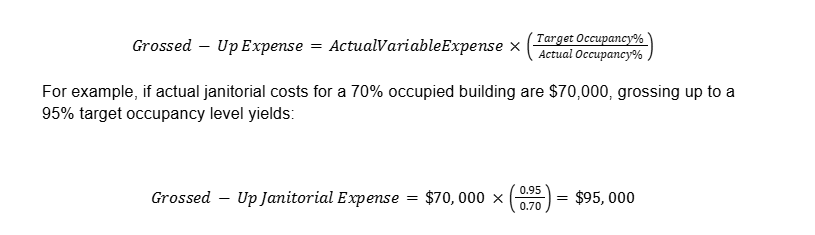
In commercial buildings that experience vacancy, variable operating expenses (such as janitorial services, trash removal, common area utilities, shared cleaning services, and utilities) fluctuate based on occupancy levels. Actual maintenance costs can also fluctuate throughout the year because of seasonality, occupancy, and service events. If a 100,000-square-foot building is only 70% occupied, total variable costs will naturally appear lower. However, if the landlord passes these costs through without adjustment, full-building expenses are understated, creating distorted baseline projections for future years.

To solve this, commercial leases include a gross-up clause. This clause authorizes the landlord to adjust variable operating expenses to reflect what those expenses would have been had the building been fully occupied (typically benchmarked at 90% to 95% occupancy), including certain maintenance expenses where the lease allows.

The standard formula for grossing up variable expenses is:

Accounting teams must carefully separate fixed expenses (such as property insurance or base real estate taxes) from variable expenses during this calculation. Fixed expenses must never be grossed up, as they do not vary with building occupancy. Variable CAM items may also include security services, including alarm monitoring, when the lease permits.

Pro-Rata Share Precision

A tenant’s pro-rata share determines their fractional responsibility for total building CAM charges, and CAM fees are typically calculated by multiplying that share by total CAM expenses. The standard calculation appears straightforward:

In this formula, the numerator is the tenant’s square footage, and the denominator is the gross leasable area or total rentable area. Some landlords also compare usable square footage to rentable area when allocating costs under the lease structure. Area maintenance CAM charges can vary based on lease type and property location even when the pro-rata method is similar. Despite its simplicity, errors frequently occur in the denominator. Landlords occasionally substitute “Occupied Square Feet” for “Total Building Rentable Square Feet” in the denominator during periods of high vacancy. This error shifts the financial burden of vacant spaces onto existing tenants, artificially inflating their pro-rata percentage and creating significant budget variance.

What Are the 3 Best Strategies to Align CAM Estimates with Actuals?

To eliminate surprise true-up liabilities and maintain steady cash flow, finance leaders and lease managers should apply three core strategies during budget preparation.

Strategy 1: Implement Dynamic Expense Tracking and Quarterly Audit Trails

Waiting for year-end reconciliation statements guarantees budget variances. Instead, adopt a quarterly audit framework to track actual landlord spend against initial monthly billing statements.

Key actions for dynamic expense tracking:

  • Request quarterly general ledger (GL) detail reports from property managers to spot cost spikes early in the fiscal cycle.
  • Compare line-item expenditures against prior-year actuals to identify trending variances in utilities, security, or seasonal maintenance, and use historical trend analysis to review how CAM costs have moved over time.
  • Establish clear accounting thresholds; flag any line item exceeding a 5% variance for immediate landlord review and clarification, and make sure projections in cam estimates also account for inflation.
  • Archive all monthly billing statements, utility invoices, and property manager notices in a central digital database for rapid year-end cross-validation.

Strategy 2: Enforce Contractual Caps and Base-Year Exclusions

Lease contracts often include protective mechanisms designed to cap expense growth and exclude non-operational costs. However, these clauses are ineffective unless actively enforced during budget season.

To enforce lease protections:

  • Audit Controllable Caps: Verify that controllable expenses (e.g., security, janitorial, administrative fees) do not exceed the agreed annual cap percentage (e.g., 5% compounded annually), since many commercial leases include audit rights and cost limitations that must be enforced actively.
  • Verify Cumulative vs. Non-Cumulative Terms: Ensure landlords do not roll over unused cap allowances from previous years unless explicit cumulative wording exists in the agreement.
  • Remove Capital Expenditures: Exclude structural repairs, roof replacements, building additions, and environmental remediation costs that landlords incorrectly include in routine maintenance categories; such items should be billed separately only if the lease expressly permits amortized recovery.
  • Validate Gross-Up Provisions: For gross leases with base-year structures, ensure property managers calculate gross-up provisions accurately based on actual building occupancy rates without grossing up fixed charges, which helps control overall occupancy costs.

Strategy 3: Standardize Vendor Bidding and Inflationary Modeling

External economic factors drive significant shifts in utility pricing, municipal property taxes, and property insurance premiums. Property managers and corporate tenants must model these uncontrollable items using realistic market data rather than static historic averages.

To standardize forecasting inputs:

  • Mandate competitive vendor bidding for major maintenance contracts (e.g., HVAC service, janitorial, landscaping, security) every 2 to 3 years.
  • Model property tax adjustments based on local municipal reassessment schedules, tax rate changes, and ongoing assessment appeals rather than generic inflation assumptions.
  • Evaluate regional property insurance rate trends, particularly for assets located in flood, hurricane, or wildfire risk zones, where premiums can spike unexpectedly.

Step-by-Step Procedure: How to Reconcile CAM Estimates in Budget Season

Follow this structured, four-step procedure during budget season to reconcile prior-year estimates, verify actuals, and set precise monthly billings for the coming year.

Step 1: Gather Master Leases, Amendments, and Reconciliation Statements

Collect all primary legal contracts, side letters, commencement date memorandums, and landlord billing statements for the target asset portfolio.

Organize key document data points:

  • Usable vs. rentable square footage metrics for both tenant space and the total building.
  • Base-year figures, expense stop thresholds, and gross-up target percentages.
  • Specific exclusions (e.g., executive salaries, leasing commissions, legal fees, advertising expenses).
  • Approved administrative and management fee percentages and cap structures.

Step 2: Extract General Ledger Line Items and Categorize Expenses

Obtain the landlord’s detailed general ledger statement for the operating year. Map every line item to its appropriate category within your lease accounting software so shared expenses tied to maintaining shared spaces are classified correctly.

Separate line items into:

  • Fixed base rent obligations.
  • Controllable CAM expenses (e.g., landscaping, interior janitorial, routine repairs, snow removal).
  • Uncontrollable CAM expenses (e.g., property taxes, building insurance, municipal water/sewer).
  • Non-recoverable landlord expenses (e.g., tenant improvement costs, legal fees for lease negotiations), while treating recoverable property management services according to the lease.

Step 3: Run Contractual Cap and Gross-Up Calculations

Apply contractual formulas to calculate the maximum allowable tenant liability for the operating period.

Work through the math step-by-step:

  1. Calculate baseline controllable expenses from the prior year or base year.
  2. Apply the contractual annual cap percentage to establish the maximum charge ceiling for the current year.
  3. Apply occupancy gross-up formulas for variable costs if building occupancy fell below full capacity during the year.
  4. To calculate CAM fees, apply the tenant’s pro-rata share to the allowable CAM pool after caps and gross-up adjustments, using verified square footage ratios and the gross leasable area identified in the lease documents as the denominator.

Step 4: Reconcile Payments and Issue Formal Audit Notices

Compare total monthly estimated payments made during the year against the calculated final liability.

Determine the net result:

  • Overpayment: Issue a formal credit request or apply the overpayment balance toward upcoming monthly rent payments as permitted by the lease.
  • Shortfall: Verify the legitimacy of the landlord’s true-up invoice before issuing final payment.
  • Formal Audit Window: If major discrepancies appear, issue a written audit notice within the contractual window (typically 30 to 90 days) to protect your rights under the lease.

In-Depth Analysis: Navigating Complex Lease Structures

Understanding how different lease structures impact CAM estimates and actual reconciliations is vital for corporate tenants managing diverse, multi-location portfolios.

1. Triple Net (NNN) Leases

In a net lease environment, tenants pay base rent plus 100% of their pro-rata share of operating expenses, property taxes, and building insurance. Because the tenant bears full operational cost exposure, accurate budgeting relies heavily on landlord transparency.

  • Key Audit Focus: Verify that capital replacements are amortized rather than expensed in full. Ensure insurance policy allocations cover only the target property, not umbrella coverage across unrelated landlord assets.
  • Budget Strategy: Request landlord operating budgets 60 days before the start of the fiscal year. Build conservative inflation buffers (5% to 8%) into tax and insurance categories.

2. Modified Gross Leases with Base Years

In base-year leases, base rent covers operating expenses up to the total cost incurred during a designated “base year” (typically the first calendar year of the lease), while a modified gross lease keeps some costs in base rent and charges others as CAM. By contrast, in double net leases tenants usually pay property taxes and insurance only, while the landlord covers other common-area costs. In subsequent years, the tenant pays only their pro-rata share of expense increases that exceed the base-year benchmark.

  • Key Audit Focus: Protect the integrity of the base-year baseline. If the base year contained artificially low expenses (due to landlord tax appeals or low occupancy), the baseline will be understated, causing artificially high pass-throughs in future years.
  • Budget Strategy: Re-evaluate base-year gross-up calculations annually. Ensure initial base-year numbers are adjusted upward if building services were expanded or occupancy increased in later years.

3. Industrial Gross and Full-Service Gross Leases

Full-service gross leases are common in many multi-tenant office building settings, where gross leases include all operating costs in a flat rental rate, including standard operating expenses, utilities, and janitorial services. However, these leases often contain expense stops or utility surcharge clauses that trigger additional billings if consumption exceeds baseline limits.

  • Key Audit Focus: Review after-hours HVAC charges, sub-metered electricity readings, and specialized janitorial additions to prevent double-billing for standard building services.
  • Budget Strategy: Install sub-meters where possible to verify actual utility consumption patterns against landlord estimates.

What Are the Most Common Pitfalls in CAM Alignment?

Avoiding common administrative mistakes ensures your finance team does not pay invalid invoices or miss critical audit deadlines.

Pitfall 1: Missing Audit Deadline Windows

Most commercial lease agreements contain strict audit limitation clauses. If a tenant fails to request backup documentation or challenge a reconciliation invoice within 30, 60, or 90 days of receipt, they forfeit their legal right to challenge those charges permanently. Always prioritize auditing incoming statements immediately upon receipt.

Pitfall 2: Accepting Unaudited Management Surcharges

Landlords routinely add a 3% to 5% administrative or property management fee on top of total operating expenses, and administrative costs should be audited alongside these surcharges. However, some landlords double-count these fees by charging both an external management company invoice and an internal administrative surcharge, which may duplicate embedded property management services already recovered elsewhere. Carefully audit management line items to eliminate duplicate charges.

Pitfall 3: Miscalculating Pro-Rata Share Ratios

A tenant’s pro-rata share depends on two metrics: tenant square footage (the numerator) and total building rentable square footage (the denominator). Landlords sometimes calculate pro-rata shares using occupied space rather than total rentable space in the denominator, inflating the tenant’s expense share. Always verify that the denominator reflects total building square footage.

Pitfall 4: Ignoring Base-Year Adjustments

In gross leases, pass-through expenses only trigger when operating costs exceed the initial base-year amount. If a landlord artificially depresses base-year expenses through deferred maintenance or one-time utility credits, future year-over-year increases will appear artificially inflated. Ensure base-year calculations accurately reflect full operational costs.

Comprehensive Troubleshooting Matrix for CAM Discrepancies

When actual CAM billings diverge significantly from annual estimates, finance and lease management teams must systematically isolate, investigate, and resolve discrepancies.

Discrepancy Type Root Cause Verification Action Resolution Mechanism
Unexplained Utility Spikes Sub-metering errors, after-hours consumption charges, or seasonal rate increases. Request interval utility meter data and daily operating schedules from property engineering. Re-bill excess consumption to specific after-hours tenants; correct faulty sub-meters.
Excessive Management Fees Admin percentage applied to excluded items (e.g., real estate taxes or capital projects). Recalculate administrative fee base after stripping out taxes, insurance, and CapEx. Issue credit memo removing admin fees assessed on non-controllable or excluded expenses.
Cap Overrun Discrepancies Landlords applied a simple annual cap instead of a cumulative cap, or ignored the cap entirely. Cross-reference baseline controllable charges against master lease cap terms. Recalculate controllable charges using contractual cap ceiling; adjust total invoice balance.
Tax Reassessment Shortfalls Landlords failed to budget for municipal property tax increases following building sale or renovation. Review local county tax assessor records and property tax appeal documentation. Negotiate structured payment terms for retroactive tax billings; update baseline for upcoming year.
Square Footage Mismatches Building expansion or re-measurement altered the rentable area without updating tenant lease addendums. Audit architect floor plans, BOMA measurement standards, and official lease amendments. Adjust pro-rata percentage in lease sub-ledger; apply retroactive credit for overpayments.

Frequently Asked Questions (FAQ)

What is the difference between a gross lease with a base year and a triple net (NNN) lease?

In a triple net (NNN) lease, the tenant pays their pro-rata share of all operating costs, property taxes, and building insurance from day one. In a gross lease with a base year, the landlord pays operating costs up to the initial base-year amount, and the tenant only pays for expense increases that exceed that initial baseline in subsequent years.

How do cumulative and non-cumulative CAM caps differ?

A non-cumulative cap limits controllable expense increases to a set percentage each year (e.g., 5% maximum annual increase). A cumulative cap allows unused cap capacity from previous low-cost years to roll forward, enabling the landlord to charge higher cost increases in future years provided the overall multi-year average remains within the capped rate.

Can a tenant withhold rent while auditing CAM reconciliation statements?

In almost all commercial lease agreements, withholding rent is a material lease breach, regardless of active CAM disputes. Tenants should pay disputed charges under formal written protest, clearly stating that payment does not waive their contractual audit rights or claim remedies.

What happens if a landlord refuses to provide general ledger backup for CAM actuals?

If a landlord refuses backup documentation within the contractual review window, issue a formal written notice of default citing the audit provisions in your lease agreement. Most commercial leases legally require landlords to provide supporting invoices, tax bills, and general ledger reports upon reasonable written request.

How can outsourcing CAM reviews simplify budget season?

Reviewing complex legal contracts and detailed accounting ledgers requires specialized skill sets and substantial administrative time, and outsourced reviews help both the property owner and tenant understand CAM fees that vary by lease type and property location. Partnering with professional lease abstractors and auditors at Re BackOffice streamlines the review process, ensures strict enforcement of lease caps, and identifies hidden overcharges before budgets are finalized.

Final Thoughts: Master Your CAM Budget Alignment Today

Aligning CAM estimates with actual operating expenses during the annual budget season is essential for maintaining accurate financial forecasts and protecting operational profitability. By deploying continuous quarterly expense tracking, enforcing lease caps, and completing rigorous year-end audits, real estate professionals can eliminate budget volatility and ensure complete contract compliance.

CAM estimates are primarily a commercial real estate concern, since CAM charges generally do not apply to purely residential leases.

Don’t let unverified landlord reconciliations and overlooked billing errors drain your operating funds. Partnering with an expert lease administration company like Re BackOffice delivers the accuracy, audit depth, and portfolio transparency needed to navigate budget season with total confidence.

Rebo-contact-us

About the Author

Rukmani Anantharaman
Marketing Director at RE BackOffice

Rukmani Anantharaman is the Marketing Director at RE BackOffice, specializing in building awareness and thought leadership around lease administration, lease abstraction, and CAM reconciliation. She creates insightful, industry-focused content that helps CRE firms, retailers, corporates, and REITs better understand, streamline, and optimize their lease operations for improved accuracy and cost efficiency.


LinkedIn

RE BackOffice Sets a New Benchmark for Excellence with an NPS Score of 83

RE BackOffice Achieves an NPS Score of 83: Setting the Standard for Excellence

RE BackOffice is proud to have achieved an exceptional Net Promoter Score (NPS) of 83, placing us firmly in the category of world-class service providers. 

Our score of 83, on a scale ranging from -100 to +100, highlights our dedication to delivering unparalleled services in lease administration, abstraction, and CAM reconciliation. This achievement positions us significantly above industry benchmarks, showcasing the strength of our client relationships and our commitment to exceeding expectations

What is NPS and Why Does It Matter?

Net Promoter Score (NPS) is a metric used by businesses worldwide to measure customer satisfaction and loyalty. Developed by Fred Reichheld in 2003, NPS has become the gold standard for understanding how customers feel about a company.

The metric is based on one simple yet insightful question:
“How likely are you to recommend our services to a friend or colleague?”

Customers respond by giving a score from 0 to 10, and based on their responses, they are classified into three categories:

  • Promoters (9–10): Loyal and enthusiastic customers who actively recommend your business.
  • Passives (7–8): Satisfied but not thrilled customers who are neutral and less likely to promote your services.
  • Detractors (0–6): Dissatisfied customers who may share negative feedback and discourage others from engaging with your business.

Once categorized, the NPS is calculated using the following formula:

NPS=% of Promoters−% of DetractorsNPS = \% \text{ of Promoters} – \% \text{ of Detractors}NPS=% of Promoters−% of Detractors

This results in a score ranging from -100 to +100:

  • +100: The ideal score, achieved when every customer is a Promoter.
  • -100: The lowest possible score, meaning every customer is a Detractor.

Our NPS score of 83 demonstrates an exceptional level of customer satisfaction and loyalty. This means the overwhelming majority of our customers are Promoters—actively recommending our services to others.

Why NPS is a Game-Changer for Businesses

NPS is not just another customer feedback tool; it’s a strategic asset for businesses. Here’s why it’s critical:

  1. Measures Customer Loyalty: NPS provides a clear snapshot of how loyal your customers are. It goes beyond satisfaction by identifying the true advocates of your brand—your Promoters—and highlighting areas where you can improve for Detractors.
  2. Fuels Organic Growth: Promoters are more than just loyal customers—they’re brand ambassadors. Their recommendations lead to higher-quality referrals, fueling growth through trust and word-of-mouth.
  3. Enables Benchmarking: NPS allows you to compare your performance against industry standards. A score like ours, 83, sets us apart as a leader in our field and showcases our dedication to excellence.
  4. Drives Continuous Improvement: By analyzing NPS data over time, businesses can identify trends, address weaknesses, and refine their offerings to better meet customer expectations.
  5. Our Commitment to Exceptional Service: Our high NPS score reflects our unwavering dedication to delivering services that exceed expectations. But we don’t stop at the numbers. We actively use NPS insights to ensure every client feels heard, valued, and supported.

How We Maintain a High NPS

Our exceptional NPS score isn’t by chance. It’s the result of deliberate efforts in the following key areas:

    1. Personalized Solutions:
      Every client has unique needs, and we tailor our services to meet them—whether it’s lease administration, lease abstraction or CAM reconciliation.
    2. Proactive Communication:
      We believe in transparency and keeping our clients informed every step of the way. Feedback is always welcomed, and we address concerns promptly.
    3. Relentless Improvement:
      We don’t rest on our laurels. NPS feedback is our guide for continuous improvement, ensuring we stay ahead of client expectations.
    4. Leveraging AI for Scalability and Efficiency: AI helps us scale quickly, meet tight deadlines, and manage large volumes of data while ensuring accuracy. This technology allows us to deliver efficient, timely services to our clients.
    5. A Strong Focus on Quality—Human and Technological: While AI enhances efficiency, our human quality control processes ensure that every task meets our high standards. This balance between technology and expertise guarantees top-tier results.
    6. Experienced Team with Over 10 Years of Collective Expertise: With an average of over 10 years of experience, our team brings deep industry knowledge to every project. This expertise enables us to exceed client expectations.

Breaking Down Our NPS Score of 83

Let’s take a closer look at what our score of 83 means in practical terms:

  • Promoters: These customers are highly likely to recommend our services. They are the driving force behind our exceptional score.
  • Passives: While satisfied, these customers might not be as enthusiastic as Promoters. We actively work to convert Passives into Promoters by addressing their needs.
  • Detractors: With such a high NPS, our percentage of Detractors is minimal. However, we take every piece of feedback seriously and strive to resolve concerns quickly.

Achieving such a high score on the -100 to +100 scale is a testament to our commitment to customer satisfaction. It shows that our customers not only trust us but are also willing to recommend us to others.

What Our Clients Are Saying

The true measure of our success lies in the words of our clients. Here are some testimonials from our recent NPS survey:

  • “It was a pleasure working with RE BackOffice. I was very happy with the abstraction work. I appreciate the thoughtful questions that were asked during the project and excellent communication.” (A leading American Telecommunications Service Provider)
  • “Have been using RE BackOffice for our lease abstraction for about 14 years.  They are always quick to respond, accurate and very friendly. ” – (A leading American convenience store chain)
  • “We are very pleased with both of our dedicated lease administration resources at RE BackOffice. They are both very responsive and professional and are a great addition to our team!.” – (A leading American Property Management Company)
  • “I have been extremely satisfied with our dedicated lease administration resource at RE BackOffice. Their prompt attention to detail, consistent and weekly check-ins to ensure that any questions or inquiries are addressed in a timely manner with the clients that we work together on. Great communication is the focal point for success in addition to expansion of services and I hope that we can continue to grow!” (A leading American Property Management Company)

These testimonials reflect the trust and loyalty of our customers, and they drive us to continually raise the bar.

How We Use NPS to Improve

At RE BackOffice, NPS is more than just a number—it’s a tool for growth and improvement. Here’s how we leverage it:

  1. Listening to Feedback: We analyze every response carefully. Promoters help us understand what we’re doing right, while Detractors provide invaluable insights for improvement.
  2. Identifying Trends: By examining NPS trends over time, we stay ahead of customer expectations and adapt to changing needs.
  3. Taking Action: Feedback drives action. We’re committed to resolving issues for Detractors, nurturing Passives into Promoters, and maintaining the trust of our most loyal customers.
  4. Celebrating Successes: Our high NPS score is a team effort. Internally, we celebrate these wins, recognizing the hard work of our employees in delivering excellence.
  5. Why Choose Us?

Our NPS score of 83 is more than just a number—it’s proof of our commitment to delivering outstanding service. Reach out to RE BackOffice if you are-

  • Seeking assistance with lease abstraction and ongoing administration.
  • Need support with CAM reconciliation, recovery audits, or lease audits, with tight deadlines or limited resources.
  • Facing a shortage of lease administration resources and an overwhelming workload.
  • Aiming to improve operational efficiency and reduce costs without sacrificing quality.

Whether you’re looking for lease administration, lease abstraction, or CAM Reconciliation, we’re here to deliver with excellence.

A Commitment to Excellence

At RE BackOffice, customer satisfaction isn’t just a priority—it’s our mission. Our exceptional NPS score reflects the trust and loyalty of our clients, and we’re dedicated to maintaining and exceeding these standards.

RE BackOffice Inc. (REBO) is a global boutique firm specializing in real estate marketing and lease services. Our Lease Services Group (REBOlease.com) provides Lease Administration, Lease Abstraction, CAM Reconciliation and Recovery Audit services to clients across diverse industries, covering every type of lease on any lease administration platform. Since 2006, we have diligently served over 1000 clients giving us the experience needed to be a trusted partner. Whether we are utilizing this comprehensive expertise or harnessing the power of our proprietary lease abstraction software, we bring an unparalleled strategic and financial advantage to our clients.

If you’re ready to work with a team that puts your needs first, Contact Us Today. Let us show you why so many customers are promoters of our business.

RE BackOffice

RE BackOffice and Nakisa join forces to elevate real estate portfolio management

RE Backoffice + Nakisa

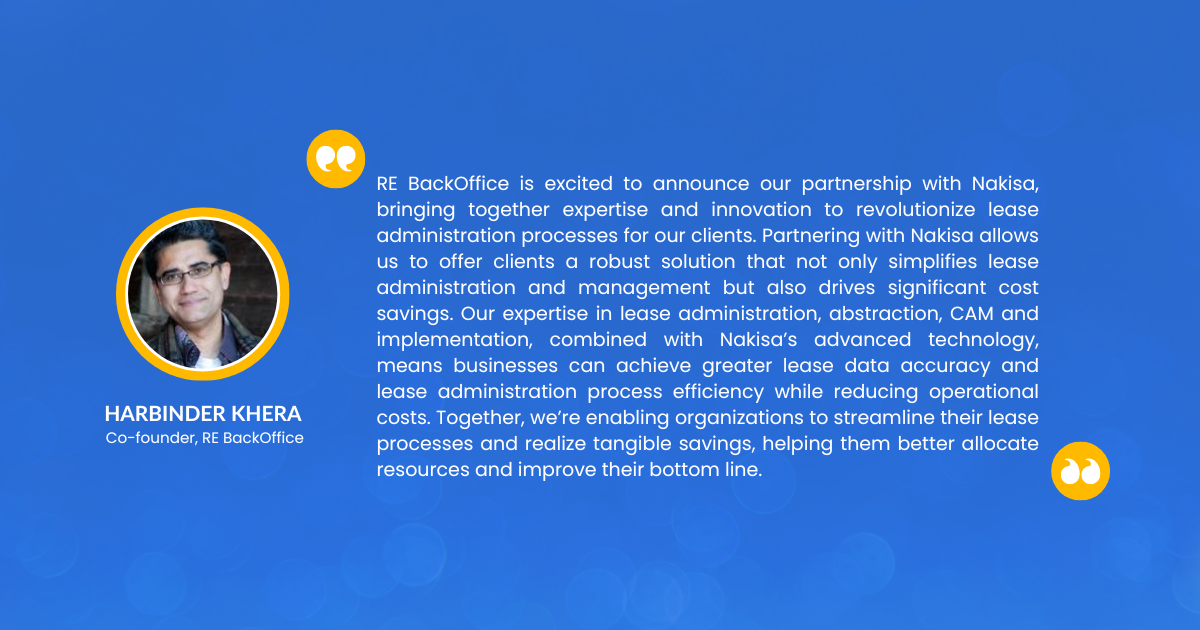
RE BackOffice, a leading provider of lease administration, abstraction and CAM reconciliation and recovery audit services, is excited to announce a strategic partnership with Nakisa,a trusted cloud-native enterprise software provider, specializing in Integrated Workplace Management System (IWMS), lease management and lease accounting. Together, we look forward to delivering enhanced value for clients by innovating real estate portfolio management processes, offering strategic benefits, and creating faster, more efficient workflows.

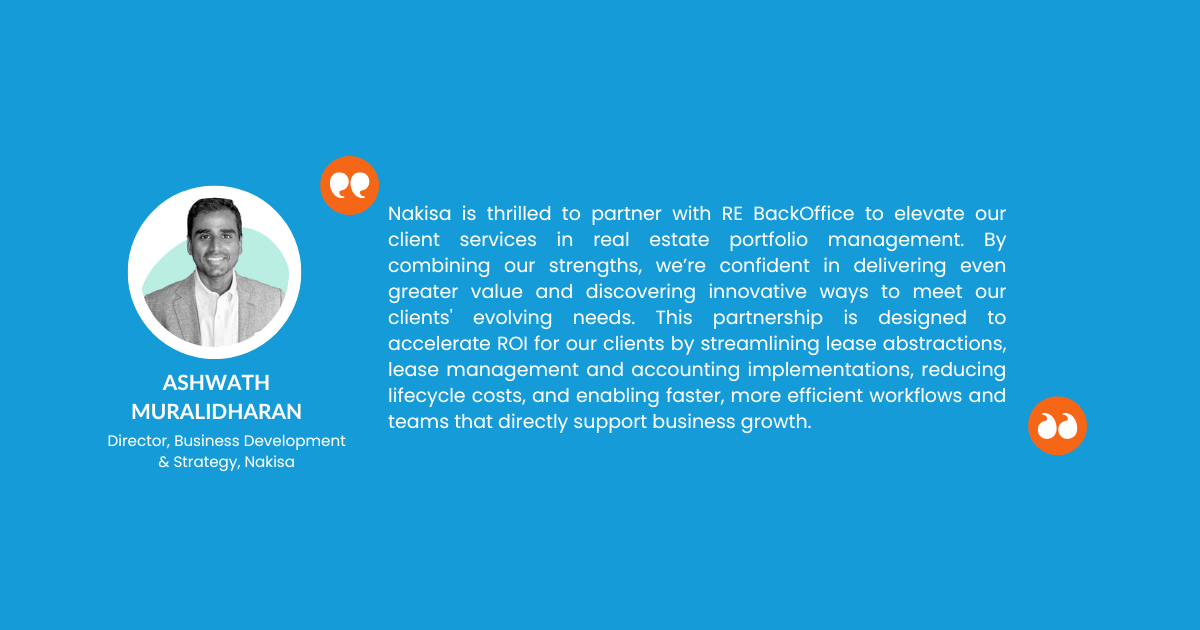
By joining forces, we aim to serve our clients even better. Our partnership will empower our clients to streamline lease abstractions, optimize lease management and accounting processes, and reduce lifecycle costs, ultimately accelerating ROI. Together, we’re committed to addressing the evolving needs of real estate teams, transforming portfolio management, and driving sustainable business growth with more agile, efficient workflows.

Harbinder Khera on partnership with Nakisa

Ashwath on partnership with RE BackOffice

About RE BackOffice, Inc.

RE BackOffice, Inc. (REBO) is a global boutique firm specializing in real estate marketing and lease services. REBO’s Lease Services Group (REBOlease.com) provides Lease Administration, Lease Abstraction, CAM Reconciliation and Recovery Audit services to clients across diverse industries. Since 2006, REBO has diligently served over 1,000 clients bringing an unparalleled strategic and financial advantage to them.

About Nakisa

Nakisa is a leading enterprise-grade application provider, offering Integrated Workplace Management System (IWMS) software alongside accounting and workforce planning solutions. With a presence in over 135 countries, Nakisa supports over 1,100 enterprise clients and 6.6 million users, including global leaders such as Walmart, Pfizer, Puma, Nestlé, ExxonMobil, and Airbus.

In the IWMS space, Nakisa delivers a comprehensive solution tailored to address complex needs in capital project management, lease management and accounting, as well as facility and energy management. By uniting finance, real estate, and facility management teams through role-based and team-specific workflows, Nakisa enables a seamless flow of financial and general ledger data. Its native ERP integrations and robust APIs ensure real-time synchronization with ERPs and other systems, providing accurate data insights.

Built on an open cloud-native platform and powered by advanced technologies like Kubernetes, Kafka, and CI/CD frameworks, Nakisa offers unmatched flexibility, scalability, and rapid innovation. Its automation capabilities have helped enterprises achieve over $2 million in annual savings by enhancing time efficiency and reducing errors.

Why is a lease administrator essential for effective lease administration and management?

Lease Administrator, Lease Administration, lease management

A lease administrator plays a critical role in the efficient management of real estate leases. This role ensures that all lease-related activities, from document management to compliance, are handled meticulously, allowing property owners and managers to focus on strategic decision-making. This blog will explore the duties of a lease administrator, why their role is vital, and how effective lease administration contributes to successful lease management.

Who is a lease administrator?

A lease administrator is responsible for overseeing and managing lease agreements throughout their lifecycle. This includes ensuring compliance with lease terms, maintaining accurate records, and facilitating clear communication between landlords and tenants. The lease administrator serves as the backbone of lease management, providing the necessary support to keep lease operations running smoothly.

What are the Duties of a Lease Administrator

Here’s what is typically included in the job description of a lease administrator-

1. Lease Documentation and Record Keeping

One of the primary duties of a lease administrator is to maintain comprehensive records of all lease agreements. This includes the initial lease documents, amendments, renewals, and any other related paperwork. Accurate record-keeping is essential for ensuring that all parties are aware of their obligations and for resolving any disputes that may arise.

2. Lease Abstraction and Data Entry

Lease abstraction involves extracting critical information from lease documents, such as rent amounts, renewal options, and termination clauses. This information is then entered into a lease management system, making it easy to track and manage lease terms. A lease administrator must be proficient in data entry and have a keen eye for detail to ensure that all information is accurate and up-to-date.

3. Rent and Payment Management

A lease administrator is responsible for tracking rent payments and other financial obligations outlined in the lease agreements. This includes ensuring that rent is collected on time, handling any discrepancies or late payments, and maintaining detailed financial records. Effective rent management is crucial for maintaining cash flow and ensuring the financial health of the property portfolio.

4. Compliance and Risk Management

Ensuring compliance with lease terms and local, state, and federal regulations is a key responsibility of a lease administrator. This involves staying up-to-date with relevant laws and regulations, identifying potential risks, and implementing measures to mitigate those risks. Compliance management helps protect property owners from legal issues and financial penalties.

5. Tenant Relations and Communication

A lease administrator acts as a liaison between landlords and tenants, addressing any inquiries or concerns related to lease terms and conditions. Effective communication is essential for maintaining positive tenant relationships and ensuring that any issues are resolved promptly. This role requires strong interpersonal skills and the ability to handle conflicts professionally.

6. Lease Renewals and Terminations

Managing the lease renewal and termination processes is another important duty of a lease administrator. This includes negotiating renewal terms, coordinating inspections, and handling final settlements. Ensuring a smooth transition during lease renewals and terminations helps maintain occupancy rates and minimize vacancy periods.

7. Financial Reporting and Analysis

Generating financial reports related to lease portfolios is a critical task for a lease administrator. These reports provide valuable insights into rental income, lease expirations, and other key metrics. Analyzing this data helps property managers make informed decisions about lease management strategies and identify opportunities for cost savings.

Why a Lease Administrator is Important

1.Ensuring Financial Accuracy

Accurate lease administration ensures that rent payments and other financial obligations are tracked correctly. This is essential for maintaining accurate financial records, budgeting, and financial planning. Without precise lease management, property owners risk financial discrepancies that can impact profitability.

2. Mitigating Legal and Financial Risks

A lease administrator ensures that lease agreements comply with all relevant laws and regulations, reducing the risk of legal issues and financial penalties. By proactively identifying and mitigating potential risks, lease administrators help protect property owners and managers from costly disputes and litigation.

3. Improving Operational Efficiency

Efficient lease administration streamlines lease-related processes, reducing the time and effort required to manage lease agreements. This allows property managers to focus on other important aspects of property management, such as marketing and tenant retention. Improved operational efficiency leads to better overall performance and profitability.

4. Enhancing Tenant Satisfaction

Effective communication and prompt resolution of tenant inquiries and concerns contribute to higher tenant satisfaction. A lease administrator plays a key role in maintaining positive tenant relationships, which can lead to increased tenant retention and reduced turnover rates. Satisfied tenants are more likely to renew their leases and recommend the property to others.

5. Supporting Strategic Planning

Detailed lease data and financial reports generated by lease administrators provide valuable insights for strategic planning. Property managers can use this information to make informed decisions about property investments, lease negotiations, and portfolio management. Accurate data supports better decision-making and long-term planning.

The Skills and Qualities of an Effective Lease Administrator

To be effective in their role, a lease administrator must possess a unique set of skills and qualities:

1. Attention to Detail

Lease administrators must manage numerous lease documents and financial records, requiring a high level of accuracy and attention to detail. Even small errors can lead to significant issues, so meticulousness is essential.

2. Analytical Skills

Analyzing lease terms and financial data is a critical part of lease administration. Strong analytical skills enable lease administrators to identify trends, detect discrepancies, and make informed decisions.

3. Communication Skills

Effective communication with tenants, landlords, and other stakeholders is crucial. A lease administrator must be able to convey information clearly and professionally, whether in writing or verbally.

4. Organizational Skills

Managing multiple leases and related tasks requires strong organizational skills. Lease administrators must be able to prioritize tasks, manage their time effectively, and maintain organized records.

5. Legal Knowledge

Understanding lease law and regulations is vital for ensuring compliance and mitigating risks. Lease administrators must stay informed about changes in legislation and how they impact lease agreements.

6. Technical Proficiency

Proficiency with lease management software and financial reporting tools is necessary for modern lease administration. Lease administrators should be comfortable using technology to streamline processes and improve efficiency.

The Relationship Between Lease Administration and Lease Management

While lease administration focuses on the detailed management of lease documents and compliance, lease management encompasses a broader range of activities. Lease management involves strategic oversight of lease portfolios, including property acquisition, lease negotiation, and long-term financial planning. Lease administrators play a key role within the broader scope of lease management by ensuring that all lease-related activities are executed accurately and efficiently.

The Future of Lease Administration

Technological advancements are transforming the field of lease administration. Advanced lease management software, automation, and artificial intelligence are making it easier to manage large lease portfolios, reduce errors, and improve overall efficiency. These technologies are streamlining data entry, financial reporting, and compliance management, allowing lease administrators to focus on higher-level tasks.

As the complexity of lease agreements and regulatory requirements continues to increase, the demand for skilled lease administrators is likely to grow. Ongoing education and professional development are essential for lease administrators to stay current with industry trends and best practices. By embracing new technologies and continuously improving their skills, lease administrators can remain valuable assets to property owners and managers.

A lease administrator is an essential component of effective lease management. Their detailed-oriented work ensures the smooth operation of lease agreements, compliance with legal requirements, and accurate financial reporting. As the real estate industry continues to evolve, the role of the lease administrator will remain crucial, adapting to new technologies and regulatory landscapes.

Understanding the importance of lease administration and the skills required to excel in this role can help property owners, managers, and tenants appreciate the value these professionals bring to the table. Whether you are a property manager looking to improve your lease management processes or a tenant seeking a better understanding of your lease terms, recognizing the role of a lease administrator is essential for navigating the complexities of lease agreements.