Lease Administration Best Practices for Managing Critical Dates and Obligations

Managing critical lease dates and contractual obligations isn’t just about setting a calendar reminder. It’s about protecting your bottom line. To get it right, you need to centralize your agreements, run rigorous data abstraction, and set up automated alerts 12 to 18 months in advance. Get these lease administration best practices right, and you avoid massive holdover penalties while keeping your early termination and expansion rights intact.

For corporate real estate leaders, legal counsel, and the C-suite, this is exactly why partnering with specialized lease administration services like RE BackOffice makes sense. It stops missed deadlines in their tracks, protects portfolio liquidity, and gets your multi-location assets performing the way they should.

What Are the Core Concepts of Critical Date and Obligation Governance?

If you’re a real estate VP or corporate counsel, missing a notification deadline in a commercial lease isn’t just an administrative oops it’s an unhedged financial liability. Whether a missed date triggers a 200% holdover rent penalty, locks an underperforming site into a five-year renewal, or leaves a massive tenant improvement allowance (TIA) on the table, passive calendar tracking is a massive risk.

Translating dense legal language into actual operational triggers means knowing the difference between a static calendar date and a conditional financial obligation.

Obligation Category Contractual Definition Operational Trigger Window Executive Financial Risk
Renewal & Extension The tenant’s right to extend occupancy at a pre-negotiated or fair market rate (FMR). 9 to 18 months prior to expiration; often requires certified mail. Forced open-market renegotiation at higher rates, or an expensive relocation.
Early Termination The right to exit an underperforming location, often tied to gross sales or co-tenancy failures. Strict 30-to-60-day window right after a specific measurement period. Forfeiting the exit right, locking the business into millions in dead rent.
ROFO / ROFR Preemptive rights to lease adjacent space before it hits the open market. Fast 5-to-15-business-day response window once the landlord gives notice. Losing the chance to expand contiguously, forcing fragmented operations.
TIA Sunsets Deadlines to submit contractor invoices and lien waivers to claim build-out funds. Usually 6 to 12 months after lease commencement or build-out completion. Losing landlord capital reimbursements forever, inflating your upfront CapEx.
End-of-Term Restoration Rules for HVAC upkeep, environmental tests, or returning the space to a “vanilla shell.” Continuous compliance, with major inspection gates 6 months before expiration. Heavy punitive restoration charges and holdover penalties from the landlord.

Why Do Enterprise Portfolios Still Miss Critical Lease Dates?

Most large organizations already pay for top-tier platforms like Yardi, MRI Software, Visual Lease, LeaseAccelerator, or Lucernex. Yet, even with millions invested in tech, notice windows lapse and unexpected lease rollovers happen. The problem usually isn’t the software interface; it’s the operational workflow feeding it.

1. Confusing Effective Dates with Legal Notice Windows

A classic mistake happens when administrative teams log the lease expiration date (say, December 31, 2028) instead of calculating backward to the legal notice window. If you need to give 12 months’ written notice to renew, your hard deadline is December 31, 2027. Add four to six months for internal corporate approvals (operations, finance, legal), and you really need to be acting by summer 2027. If you only log the final expiration date, you have zero runway to negotiate.

2. Unstructured Side Letters and Subsequent Amendments

Over a ten-year term, a single property might rack up three amendments, an expansion addendum, and an estoppel certificate. Too often, the original master lease gets abstracted, but all those subsequent amendments just get saved as flat PDFs on a shared drive. When an amendment changes a termination option and nobody updates the master database, your data is stale and your legal exposure is immediate.

3. Conditional Obligations Buried in Dense Legal Text

Modern commercial leases are packed with strict conditions. You might have an early termination option, but only if you aren’t in default, have hit specific sales targets, and deliver the notice via overnight courier to three different landlord addresses. Standard Optical Character Recognition (OCR) tools grab the calendar date but completely miss these conditions, leading to legally defective notices that landlords will gladly reject.

4. Post-M&A Integration Blind Spots

Mergers and acquisitions dump a mountain of inherited leases onto your lap, all with different regional standards and legacy formatting. If you don’t run immediate forensic abstraction on that newly acquired portfolio, critical notice windows will quietly expire during the integration phase, trapping the new combined enterprise in redundant real estate.

The Legal and Financial Impact of Unmanaged Obligations

In commercial real estate, US courts almost universally enforce lease notice deadlines to the exact day and delivery method.

  • Strict Enforcement of Notice Formalities: In a tight market, landlords actively hope you miss your renewal window so they can reset base rents to market rates. In a soft market, they will scrutinize your early termination notice for any technical defect—like sending it via email instead of certified mail to invalidate it and keep you on the hook.
  • Compounding Holdover Economics: If your lease expires without a formal extension, holdover clauses kick in immediately. You’re usually looking at 150% to 200% of your final month’s rent, plus operating expenses, and potential liability if you block the next tenant from moving in.
  • Balance Sheet Volatility: Unmanaged dates wreck financial reporting. Accounting teams have to evaluate if you are “reasonably certain” to renew or terminate to calculate the Right-of-Use (ROU) Asset and Lease Liability. Last-minute real estate decisions cause unexpected balance sheet remeasurements and trigger heavy scrutiny from external auditors.

How to Implement Enterprise Lease Administration Best Practices

To get total operational control, corporate real estate and legal teams need an auditable workflow. Here is how to build it:

Step 1: Execute Institutional-Grade Multi-Tier Abstraction

Don’t rely on software alerts until your data is bulletproof. Abstract more than just rent and expiration dates. Capture every conditional option, co-tenancy remedy, and TIA sunset. Use a two-tier review process where a senior analyst verifies the data against the legal source documents to catch OCR mistakes. Make sure you document the exact delivery methods and current landlord addresses required for legal notices.

Step 2: Configure Cascading Alert Timelines

Ditch single-date reminders. Set up cascading alerts based on how long it actually takes your company to make a decision:

  • 18 Months Out: Trigger a portfolio review alert to evaluate site profitability and market rents.
  • 12 Months Out: Start financial modeling and broker surveys to build negotiation leverage.
  • 6 Months Out: Get formal executive sign-off on the strategy (renew, relocate, terminate) and have a legal draft of the notice.
  • 60 to 90 Days Out: Do a final legal check for technical defaults, verify the landlord’s address, and track the certified courier receipt.

Step 3: Tie Obligations into Facility Workflows

Log percentage rent deadlines, insurance certificate renewals, and preventative maintenance rules (like quarterly HVAC servicing) directly into facility management schedules. Set hard alerts 90 days before TIA allowance expirations so your team gathers all the lien waivers and certificates of occupancy in time to get paid.

Step 4: Synchronize with Financial Accounting

Set up triggers to notify accounting the moment a renewal or termination becomes “reasonably certain.” This lets them measure the Lease Liability in the right fiscal quarter. Run quarterly audits between your lease database and the general ledger to make sure rent step-ups match the legal agreements.

Managing Complex Commercial Clauses

Standard expiration tracking isn’t enough for complex mechanisms:

  • Co-Tenancy and Kick-Outs: If an anchor tenant leaves and co-tenancy remedies kick in (like dropping to percentage rent), it rarely happens automatically. You have to actively monitor occupancy rosters, track the landlord’s cure period, and send a formal election notice the moment that cure period expires.
  • Estoppels and SNDAs: When a landlord refinances, you usually have 10 to 15 days to sign an Estoppel Certificate. If you just sign their drafted version without cross-checking your abstracted lease, you might accidentally waive uncollected TIA balances or side-letter concessions.
  • End-of-Term Restoration: If a lease requires you to return a space to “vanilla shell,” you can’t wait until the last 30 days to figure it out. Contractors won’t finish in time, triggering holdover rent. Start restoration audits 6 to 9 months out so you can either finish the demolition or negotiate a cash buyout.

The Most Common Executive Blind Spots

Even great real estate teams fall into these structural traps:

  1. Trusting Verbal Extensions: A property manager emails you saying holdover penalties won’t apply while you negotiate a renewal. Legally, that informal email usually doesn’t modify a commercial contract. Always get a formal, written interim extension agreement.
  2. Missing “Evergreen” Clauses: Some leases and equipment addendums auto-renew for multiple years unless you actively opt-out within a narrow window. Miss it, and you’re locked in.
  3. Losing Track of Landlord Addresses: Properties get sold. Accounts payable updates where the rent check goes, but nobody updates the legal notice address in the lease abstract. Your option notice goes to the old owner, rendering it legally invalid.
  4. Decentralized Storage: When local managers keep executed amendments in local folders, central visibility dies. Every signed document must hit the central system of record immediately.

How RE BackOffice Elevates Obligation Management

Running this level of lease administration across hundreds of locations is a massive burden on internal teams. That’s why companies partner with RE BackOffice. They act as an extension of your real estate department to completely eliminate critical date risk.

Experienced lease analysts handle precision multi-tier abstraction, pulling over 100 data points from your documents. Because RE BackOffice is platform-agnostic, they work directly inside your existing Yardi, MRI, or Visual Lease environment.

Executive FAQ

How far in advance should we start reviewing critical dates?

For headquarters or massive distribution centers, start strategic reviews 18 to 24 months before the notice deadline (not the expiration). For standard retail or branch offices, 12 to 15 months gives you enough time for market benchmarking and internal approvals.

What happens if we miss a notice deadline by a day?

US courts strictly enforce these as conditions precedent. Being 24 hours late usually voids your right to renew at the pre-negotiated rate, forcing you into an open-market negotiation with zero leverage.

Should we manage this internally or outsource it

Keep strategic site selection and high-level negotiations in-house. But the daily grind of contract abstraction, estoppel verification, and alert monitoring is usually outsourced to free up your team. Partners like RE BackOffice reduce overhead and guarantee audit-grade accuracy.

What is the most overlooked obligation in a commercial lease?

TIA sunset deadlines and end-of-term restoration clauses. Missing a TIA deadline means forfeiting cash the landlord owes you for your build-out. Ignoring restoration covenants leads to massive last-minute construction charges and holdover rent.

Mastering lease administration turns static contracts into agile strategic assets. Protect your balance sheet from missed deadlines, holdover rates, and forfeited rights by putting the right workflows and the right partners in place.

Rebo-contact-us

About the Author
Rukmani Anantharaman
Marketing Director at RE BackOffice
Rukmani Anantharaman is the Marketing Director at RE BackOffice, specializing in building awareness and thought leadership around lease administration, lease abstraction, and CAM reconciliation. She creates insightful, industry-focused content that helps CRE firms, retailers, corporates, and REITs better understand, streamline, and optimize their lease operations for improved accuracy and cost efficiency.

LinkedIn

Understanding Common CAM Reconciliation Clauses in Commercial Property Agreements

Understanding common Common Area Maintenance clauses requires analyzing how landlords pass through operational expenses, apply controllable caps, and adjust variable charges based on occupancy benchmarks. A successful CAM Reconciliation strategy cross-references detailed general ledger accounting reports against master lease agreements to verify pro-rata share denominators, identify illegal capital expenditure pass-throughs, and enforce strict contractual audit windows. Incorporating structured software workflows and expert lease administration partners like RE BackOffice allows corporate real estate leaders to conduct an end-to-end Portfolio Audit, prevent annual cost leakage, and protect balance sheet net operating income (NOI).

What Are the Core Concepts of Commercial CAM Reconciliation Clauses?

For corporate real estate executives, CAM charges are one of the most volatile components of occupancy costs, and they can account for roughly 20% to 40% of total occupancy costs for commercial tenants. Property managers process thousands of vendor invoices annually, meaning negotiated lease exclusions, custom cap formulas, and non-standard gross-up calculations are regularly missed.

Understanding how legal lease language translates into financial obligations requires establishing clear definitions across core contract components.

CAM Clause Component Legal Definition General Ledger Impact Executive Risk Factor
Pro-Rata Share Allocations The tenant’s proportional share of building operational costs, calculated by dividing tenant usable area by total rentable area. Sets the percentage multiplier applied across all shared general ledger operational line items. Denominator shifts during building vacancies that artificially inflate the tenant’s share.
Controllable Expense Caps Negotiated annual limits on operational cost increases under property manager control (e.g., janitorial, security, landscaping). Restricts year-over-year growth of specific operating expenses to an agreed percentage ceiling (e.g., 5%). Misapplication of cumulative banked buffers or ignoring non-cumulative cap resets.
Occupancy Gross-Up Rules Provisions allowing landlords to adjust variable operating costs to reflect target building occupancy benchmarks (e.g., 90% to 95%). Scales variable expenses up to reflect full operational load while keeping fixed expenses static. Applying gross-up scaling factors across fixed expense lines like taxes and structural insurance.
Capital Expenditure Exclusions Clauses prohibiting landlords from passing through full upfront capital replacement costs as routine operating expenses. Forces landlords to capitalize major assets under GAAP and amortize costs over useful economic life. Landlords passing off full building roof or central HVAC replacements as routine repairs.

Financial analysis

What Impact Does Financial Accounting Compliance Have on CAM Auditing?

Corporate real estate accounting is directly tied to financial reporting standards. Under GAAP and international standards, lease compliance directly impacts corporate balance sheet metrics.

Balance Sheet Recognition Under ASC 842 and IFRS 16

Under current accounting frameworks, operating leases must be recognized directly on corporate financial statements. Every commercial agreement creates a Right-of-Use (ROU) Asset alongside a corresponding Lease Liability.

  • Discount Rate Valuation: Calculating baseline financial metrics requires identifying the correct Incremental Borrowing Rate (IBR) based on contract term, asset class, and corporate credit profile.
  • Variable Lease Costs: While fixed base rent drives baseline liability amortization schedules, variable operating expenses like fluctuating CAM pass-throughs are classified as variable lease expenses under ASC 842 and IFRS 16.
  • Audit Reconciliation Alignment: Unverified landlord overcharges distort variable lease expense disclosures, leading to financial statement adjustments during annual public audits.

The Critical Role of Fall Planning

Establishing financial control requires proactive operational calendars. September represents the primary window when corporate real estate teams must begin structured Lease Data Preparation and financial planning. Executing strategic September Budgeting workflows ensures that preliminary landlord operating estimates match historic spend baselines before official annual reconciliations hit accounts payable teams early the following spring.

Strategic Governance: Operational Structural Risks in Enterprise CAM Auditing

Analyzing recurring billing variances across multi-tenant commercial assets reveals distinct structural challenges in property management accounting:

1. Vendor Invoice Misclassification and Capital Bundling

The most persistent financial leak in commercial property management stems from improper cost classification in general ledger coding. Property management accounting teams routinely process thousands of contractor line items annually. As a result, major capital expenditures such as lobby upgrades, elevator modernizations, central automation upgrades, or roof replacements are frequently tagged as routine repairs and maintenance. Passing full upfront capital costs directly into annual CAM pools violates GAAP standards and inflates tenant pass-through pools.

2. Disconnect Between Lease Negotiators and Accounts Payable

Commercial leases contain highly customized financial covenants, including negotiated expense caps, exclusions for property management fees, and specific base-year stops. However, property management accounting platforms rely heavily on standardized billing templates. When property management teams rotate or corporate ownership shifts, tenant-specific side letters and negotiated exclusions are regularly lost in translation, leading landlords to default to standard pass-through formulas that ignore negotiated tenant protections, even though recoverable expenses must follow the lease agreement and may differ for tenants in the same building.

3. Cumulative vs. Non-Cumulative Cap Tracking Errors

Calculating controllable expense caps requires strict multi-year accounting logs. In cumulative cap agreements, landlords retain unused cap room from prior low-cost years to buffer future cost spikes. In non-cumulative structures, the cap ceiling resets every year based strictly on the prior year’s capped limit. Legacy ERP setups and static spreadsheets frequently fail to maintain historical banked capacity logs, resulting in incorrect pass-through billings that erode tenant net operating income.

4. Expense Pool Dilution and Controllable Reclassification

Another frequent operational friction point is the reclassification issue that often starts with the variable pool and controllable classifications used for reconciliation being shifted into uncontrollable summary lines. For instance, property managers may attempt to reclassify regular security enhancements, routine elevator service contracts, or janitorial services as emergency or compliance-driven expenditures to bypass negotiated controllable caps. Forensic accounting cross-references raw ledger sub-accounts against master lease exclusion schedules to ensure every line item remains strictly within its designated contractual pool.

How to Execute an Enterprise CAM Audit: A Step-by-Step Guide

To systematically verify operating expense pass-throughs, eliminate billing variances, and recover overpaid capital across a multi-location portfolio, real estate executives must implement a structured operational workflow.

Step 1: Ingest Contract Parameters and Track Review Windows

The moment a landlord sends an annual reconciliation statement, log the document into your central lease administration software to establish an immutable audit trail.

  • Pull verified contract parameters from your database, including pro-rata share percentages, controllable cap terms, base-year stop figures, variable gross-up targets, and explicit exclusion lists.
  • Configure automated milestone alerts based on the exact lease notice window (e.g., 30, 60, or 90 days) to prevent forfeiture of legal audit rights.
  • Prioritize statement reviews by running variance check algorithms that flag any annual expense increase exceeding pre-set portfolio thresholds (such as a 5% year-over-year jump).

Step 2: Conduct Forensic Line-Item General Ledger Reviews

Never evaluate high-level summary statements such as “General Building Operating Costs.” Demand and inspect the landlord’s detailed general ledger source code report supporting the full calendar year so you can compare billed amounts with actual charges, actual costs, and actual expenses incurred.

  • Run targeted search filters across general ledger line items to isolate capital projects, lobby upgrades, or structural replacements that must be capitalized under GAAP rather than expensed in full, and confirm the final amount reflects actual expenses rather than estimates while identifying whether each line item is recoverable under the lease.
  • Inspect property management fee line items to confirm fees are assessed strictly against eligible operational categories, excluding property taxes, building insurance, and capital assets, and verify any such allocations align with CAM fees where applicable.
  • Review insurance certificates to confirm your building is not paying for corporate umbrella policies covering unrelated assets in the landlord’s portfolio.

Step 3: Re-Calculate Expense Cap Ceilings and Gross-Up Multipliers

Independently recalculate operational totals using verified square footage metrics and lease-mandated logic rules. The annual cam reconciliation process usually occurs within 90 to 120 days after the fiscal year ends, subject to the lease.

  • Verify the pro-rata share denominator by dividing your usable space by total leasable square footage established in verified floor plans, ensuring the landlord did not substitute occupied area for total rentable area.
  • Separate operating expenses into controllable and uncontrollable categories based on specific lease definitions, since many leases cap annual increases only on controllable charges while allowing uncontrollable items to pass through outside the cap.
  • Apply cumulative or non-cumulative cap logic across multi-year periods to establish the legal expense ceiling for the audit year, incorporating banked capacity from prior low-cost years.
  • Apply variable cost gross-up adjustments strictly to variable operational categories (such as interior janitorial care and shared utilities) while keeping fixed charges static.

Step 4: Issue Formal Audit Findings and Secure Financial Recovery

If line-item variances or contract violations occur, draft a formal, legally structured audit report addressing CAM charges and other recoverable expenses permitted by the lease, detailing general ledger misallocations and calculation errors.

  • Deliver formal written audit notices directly to the landlord’s designated legal address before the contractual review window closes.
  • Issue payments for undisputed charges under formal written protest with an explicit legal reservation of rights to prevent claims of waiver.
  • Negotiate settlement credit memos to be applied directly against upcoming monthly rent disbursements or demand direct cash refunds for historical overpayments; if the tenant receives a true-up invoice because actual costs exceeded estimates, require supporting backup, and if amounts were overstated, request a credit or refund.
  • Update master database baselines with corrected financial metrics to prevent recurring errors in subsequent billing cycles.

Advanced Troubleshooting: Managing Complex High-Variance Categories

To protect portfolio cash flow, lease accounting teams must deploy specialized technical scrutiny toward four general ledger areas where calculation errors happen most frequently.

1. Capital Expenditure Amortization Schedules

When a landlord installs modern energy management systems, retrofits lighting fixtures, or performs routine HVAC repairs rather than replacing an entire HVAC system, commercial leases frequently permit passing through the amortized annual cost provided the project yields verified operational savings. Routine servicing may be CAM, but a full-system replacement is usually a capital improvement that must be excluded or amortized if the lease permits.

Your audit team must verify:

  • Did the landlord present documented engineering proof of actual net cost reductions resulting from the capital modification?
  • Does the amortization schedule follow standard IRS economic asset lifespans (typically 15 to 20 years)?
  • Did property management exclude the unamortized lump-sum capital balance from routine operating expense pools?

2. Occupancy Gross-Up Formula Audit

Occupancy gross-up provisions protect both landlords and tenants in buildings with fluctuating vacancy by scaling variable operational costs to reflect a benchmark building occupancy rate (typically 90% to 95%), and tenants typically pay estimated CAM charges or monthly CAM fees during the year based on projected annual expenses before reconciliation compares those payments to actual expenses.

To perform this calculation without relying on static spreadsheet formulas, determine the scaling ratio by dividing the target benchmark occupancy percentage by the actual building occupancy percentage. Next, multiply this ratio by the actual expenses for the variable category to establish the adjusted variable cost pool. For example, if actual janitorial costs for a building operating at 70% occupancy are $70,000 and the lease targets a 95% occupancy benchmark, the adjusted variable cost pool is calculated by multiplying $70,000 by the ratio of 0.95 divided by 0.70, yielding $95,000. This gross-up adjustment applies only to eligible variable expenses in the variable pool.

A critical audit rule applies: gross-up adjustments must apply strictly to variable operational line items, such as interior janitorial care and common area utility usage. Fixed charges such as property taxes, building insurance, and structural maintenance do not change with occupancy levels and must never be grossed up. Applying gross-up multipliers across an entire general ledger artificially inflates fixed costs and represents an improper billing practice that must be stripped out.

3. Base-Year Stabilization in Modified Gross Agreements

In modified gross or full-service leases, tenants pay for operating expense increases exceeding costs incurred during a designated base year, and these are one of several lease types that shift operating expenses differently between landlord and tenant. Landlords sometimes understate initial base-year expenses through deferred maintenance, temporary tax credits, or low building occupancy, while some triple net structures pass more cam costs directly to tenants, so the base-year analysis differs from modified gross arrangements. An artificially low base-year baseline causes every subsequent operating year’s pass-through calculation to appear artificially inflated. Corporate audit protocols must analyze base-year general ledgers to confirm that all operational expenses were fully grossed up and stabilized.

CAM analysis

What Are the Most Common Executive Blind Spots in CAM Governance?

Avoiding costly administrative and executive oversights maintains legal leverage during landlord negotiations and stops continuous cost leakage.

1. Allowing Contractual Audit Windows to Expire

The most damaging administrative error is permitting review windows to lapse. Commercial leases almost universally enforce strict time frames (typically 30, 60, or 90 days from statement receipt) for tenants to raise initial objections, though broader reconciliation periods or audit rights may run longer depending on the lease agreement. Once this window closes, most lease contracts legally bar the tenant from contesting those calculations, permanently forgiving landlord overcharges.

2. Failing to Audit General Ledger Backup Invoices

Accepting high-level property management summary letters without inspecting itemized general ledger accounts is a major operational risk. Landlords frequently bundle legal fees from tenant disputes, off-site corporate administrative overhead, and capital improvements into generic maintenance categories that can only be uncovered through line-item general ledger audits.

3. Ignoring Multi-Year Banked Cap Capacity

Evaluating controllable caps as isolated single-year calculations leads to major financial errors. Under cumulative cap agreements, landlords retain unused cap capacity from low-cost years as a banked buffer to absorb future cost spikes. Conversely, under non-cumulative cap structures, the capped ceiling resets every single year based strictly on the prior year’s capped limit. Failing to track multi-year cap logs results in unearned landlord pass-throughs.

4. Paying Disputed Reconciliations Without Reservation of Rights

Withholding rent during an operating expense dispute constitutes a material lease default under standard commercial agreements. When a disputed reconciliation statement arrives, corporate tenants must issue payment for undisputed items while delivering a formal written protest that contains an explicit legal reservation of rights detailing the line-item exceptions under review.

How Does RE BackOffice Elevate Enterprise Lease Governance?

Managing complex operating reconciliations across a multi-location footprint internally often creates operational bottlenecks and leads to missed audit windows. RE BackOffice acts as a seamless extension of your corporate real estate department, closing the gap between complex legal contracts and ongoing financial execution.

Partnering with RE BackOffice delivers direct operational capabilities:

  • Institutional-Grade Data Abstraction: Specialized lease analysts perform multi-tier verification on every contract, extracting over 100 legal, operational, and financial data points to ensure complex cap logic and gross-up rules are properly captured within your system of record.
  • Platform-Agnostic Software Integration: Rather than requiring software migrations, RE BackOffice works natively inside your existing software stack (including Yardi, MRI Software, RealPage, Visual Lease, LeaseAccelerator, Lucernex, and others).
  • Forensic CAM and OpEx Auditing: Dedicated audit teams review incoming annual landlord reconciliation packages against master lease agreements, isolating illegal capital expenditure pass-throughs, miscalculated controllable caps, and improper management fee surcharges.
  • ASC 842 & IFRS 16 Compliance Support: Experts establish verified schedule baselines, track lease modifications, and verify discount rate applications, ensuring seamless coordination with internal accounting and external CPA auditors.
  • Scalable Operational Efficiency: By transferring routine abstraction, document indexing, critical date logging, and reconciliation audits to RE BackOffice, corporate real estate leaders free up internal teams to focus on strategic footprint optimization, location planning, and high-value landlord negotiations.

Executive FAQ

What is the typical return on investment (ROI) for a formal CAM audit program?

Industry benchmark data demonstrates that comprehensive line-item auditing recovers between 3% and 8% of total annual occupancy pass-through expenses across enterprise portfolios. Beyond immediate cash refunds, correcting baseline calculation errors prevents compounded overbillings over remaining lease terms.

How do we handle landlords who refuse to provide itemized general ledger details?

If a landlord refuses general ledger access within your contractual review window, issue a formal written notice of default citing the inspection and audit provisions of your master lease. Most commercial agreements legally oblige property owners to provide verifiable backup documentation upon written request.

Can an operating expense audit trigger a negative financial exposure for our organization?

Yes. If an audit reveals that a landlord understated initial budget estimates or misapplied an expense stop in your favor, a true-up adjustment could theoretically increase your liability. Forensic preliminary desk reviews screen for these exposures before formal audit notices are served.

Should CAM auditing be managed internally or outsourced to specialized partners?

While strategic oversight remains an internal executive function, executing line-item general ledger audits, contract abstraction verification, and landlord negotiations across large portfolios is most efficiently handled by specialized partners. Tech-enabled service providers like RE BackOffice offer deep subject-matter expertise and operational scale without expanding internal payroll overhead.

What is the difference between controllable and uncontrollable CAM expenses?

Controllable expenses are operational costs directly managed by property personnel; in common area maintenance cam, they are the costs of maintaining shared spaces and can include janitorial care, security staffing, landscaping, routine maintenance, snow removal, and trash removal depending on the lease. Uncontrollable expenses are market-driven costs outside landlord control (e.g., real property taxes, building insurance, utility rates) and pass through without cap restrictions, while annual increases to controllable cam expenses are often capped.

Securing Portfolio Value Through Advanced Lease Governance

Identifying and correcting errors in annual CAM Reconciliation statements is a vital financial governance discipline for corporate real estate executives. By implementing rigorous general ledger forensic audits, enforcing contractual controllable caps, and establishing automated workflow controls, executive leaders protect portfolio margins, ensure regulatory compliance, and eliminate unearned financial pass-throughs.

Managing these complex reconciliations internally across a multi-location footprint often creates operational bottlenecks and leads to missed audit windows. Partnering with specialized lease administration experts like RE BackOffice delivers the technical depth and operational scale needed to optimize your portfolio. Their experienced team abstracts complex legal terms, validates landlord general ledger statements, enforces contractual caps, and recovers overbilled capital on your behalf.

Don’t let unverified landlord reconciliations and calculation errors erode your portfolio’s EBITDA. Partner with RE BackOffice today to establish complete financial control across your commercial real estate footprint.

Rebo-contact-us

About the Author
Rukmani Anantharaman
Marketing Director at RE BackOffice
Rukmani Anantharaman is the Marketing Director at RE BackOffice, specializing in building awareness and thought leadership around lease administration, lease abstraction, and CAM reconciliation. She creates insightful, industry-focused content that helps CRE firms, retailers, corporates, and REITs better understand, streamline, and optimize their lease operations for improved accuracy and cost efficiency.

LinkedIn

How Do Lease Administration Tools Improve Lease Audit Processes?

Let’s be honest: managing a massive commercial real estate portfolio is complicated enough without letting millions of dollars slip through the cracks in unverified landlord invoices.

For corporate real estate executives, specialized lease administration tools have become the secret weapon for transforming dense, static lease contracts into dynamic, audit-ready workflows. These platforms centralize your messy lease data, run continuous audits on line-item expenses, ensure you never miss a contractual notice window, and automate complex compliance (like ASC 842 and IFRS 16).

When you pair the right commercial real estate software with specialized managed services like RE BackOffice, the results are undeniable. You eliminate friction in invoice processing, protect your net operating income (NOI), and typically recover 3% to 8% in annual overbillings across your portfolio.

Here is a look at why manual lease audits are failing, and how modern technology can plug the leaks in your balance sheet.

The Strategic Financial Impact of Automated Auditing

If you are managing an expansive corporate footprint, unexamined landlord invoices are a massive, unhedged risk. Operating expense pass-throughs like Common Area Maintenance (CAM), real estate taxes, building insurance, and utilities often make up 25% to 40% of total occupancy costs.

Yet, because these bills arrive all at once and internal accounting teams are stretched thin, millions of dollars in landlord true-up statements get rubber-stamped through accounts payable without a second glance.

Upgrading to a tech-enabled workflow turns your lease administration from a reactive accounting chore into a proactive financial shield.

Strategic Domain The Old Way (Manual) The New Way (Tech-Enabled) The Bottom-Line Impact
Audit Coverage Spot-checking only the top 10% most expensive locations. 100% automated line-item auditing across all properties. Catches hidden billing leaks in secondary and regional locations.
Deadline Compliance Frequently losing audit rights by missing 30/60-day notice deadlines. Automated triggers and multi-stage countdowns. Preserves your legal right to audit, challenge, and recover cash.
Complex Math Flat year-over-year rate caps evaluated with no historical context. Multi-year algorithmic cap engines and gross-up calculators. Stops landlords from ignoring negotiated expense ceilings.
ERP Integration PDF contracts sitting in folders, completely disconnected from AP. Direct API syncing between lease data and your GL software. Prevents duplicate payments and speeds up annual CPA audits.

Why Enterprise Lease Audits Break Down

Most corporate real estate teams already use big-name platforms like Yardi, MRI Software, or Visual Lease. But despite spending heavily on software, portfolios continue to bleed capital every spring. Why? It usually comes down to three operational disconnects:

1. The Gap Between Legal and Accounts Payable

When you sign a lease, the legal team abstracts the document, pulling out the commencement dates and base rent to put into the system. However, the nuanced financial rules like non-cumulative expense caps or base-year tax stops often just get typed in as messy “text notes.” Later, when the CAM bill arrives, Accounts Payable just checks if the address matches and the math looks right. The subtle legal breach hidden inside the invoice passes right onto your balance sheet.

2. General Ledger Software is Too Rigid

Your standard ERP platform is great at paying base rent every month. But ERPs are notoriously terrible at reading complex, non-standard lease agreements. They can’t independently inspect a landlord’s itemized vendor receipts, spot double-counted management fees, or realize that a lobby renovation should be capitalized over 15 years rather than billed to you today.

3. The “Spring Avalanche” Capacity Bottleneck

Landlord reconciliation packages almost always arrive in a tight window between February and May. Worse, leases usually enforce strict 30-, 60-, or 90-day windows for you to legally challenge the bill. Internal teams simply do not have the bandwidth to forensically audit hundreds of line items before the clock runs out.

Procedure to Upgrade Your Lease Audit Workflow

A 4-Step Procedure to Upgrade Your Lease Audit Workflow

To stop overpaying and start recovering cash, you need a standardized, repeatable audit process. Here is how to execute it:

Step 1: Establish Automated Ingestion and Alerting Triggers

Log every incoming annual reconciliation statement into your platform immediately to avoid missing your 30-day challenge window.

  • Extract your pro-rata share, controllable caps, and exclusion lists.
  • Set automated, multi-tiered countdown alerts based on your exact contractual review window.
  • Use variance algorithms to automatically flag any annual expense that jumps more than 5% year-over-year.

Step 2: Execute General Ledger Line-Item Forensic Audits

Never accept a generic category like “Building Operational Expenses.” Demand the landlord’s complete general ledger detail.

  • Run keyword filters to catch capital improvements (like a new roof) that should be amortized over time, not expensed in full this year.
  • Ensure property management fees are only assessed against eligible categories.
  • Check tax bills to ensure regional corporate umbrella policies or landlord legal fees aren’t being passed on to you.

Step 3: Re-Run the Math and Cap Logic

Recalculate the totals yourself based on verified square footage.

  • Re-verify your pro-rata share using architectural floor plans. Make sure the landlord isn’t making you pay for current building vacancies.
  • Separate expenses into “controllable” and “uncontrollable” buckets based on your specific lease.
  • Apply gross-up adjustments only to variable costs (like janitorial care), never to fixed costs (like property taxes).

Step 4: Issue Formal Audit Findings and Recover Cash

When you find a breach or error, take immediate action.

  • Send a formal audit notice to the landlord’s legal address before your review window closes.
  • If you must pay the bill to avoid default, pay it “under formal written protest” with a reservation of rights.
  • Negotiate credit memos against future rent, or demand cash refunds for historical overpayments.

The 5 Most Common Items Landlords Improperly Include in CAM

Even well-intentioned landlords make mistakes, but some improper pass-throughs appear in general ledgers year after year. When conducting your audit, scrutinize these five frequent offenders:

  1. Capital Improvements Masked as Repairs: A landlord replaces an entire HVAC system or repaves the entire parking lot, but bills it as a “repair.” Under most leases (and GAAP rules), capital improvements must be amortized over their useful life (e.g., 15 years), meaning you should only be billed for a fraction of the cost this year, not the whole lump sum.
  2. Marketing and Leasing Commissions: Costs associated with finding new tenants, marketing the building, paying broker commissions, or outfitting vacant suites (Tenant Improvement allowances) are the landlord’s cost of doing business. They should never be passed through to existing tenants as a CAM charge.
  3. Landlord Corporate Overhead & Executive Salaries: You are responsible for the on-site property manager’s salary, but you should not be subsidizing the salaries of the landlord’s off-site corporate executives, their home office rent, or their general corporate accounting fees.
  4. Legal Fees for Landlord Disputes: If the landlord sues another tenant for unpaid rent, or defends themselves against a slip-and-fall lawsuit, those legal fees cannot be lumped into building operational expenses.
  5. Penalties, Fines, and Charitable Contributions: Late fees on the landlord’s mortgage, tax penalties for late filing, and corporate charitable donations often accidentally slip into the general ledger. None of these are valid CAM expenses.

The Technical Deep-Dive: Where Else Do Landlords Make Mistakes?

  • Occupancy Gross-Up Logic: Gross-ups protect everyone when a building is half-empty, adjusting variable costs to assume the building is ~95% full. The cardinal rule? Gross-ups only apply to variable costs. If a landlord grosses up a fixed cost like structural maintenance, they are illegally inflating your bill.
  • Controllable Expense Caps: If your lease caps expense growth at 5% a year, you have to track multi-year trends. If expenses only grew 2% last year, did the landlord “bank” that extra 3% capacity for this year? Legacy accounting systems almost always fail to track this.
  • Base-Year Stabilization: In a modified gross lease, you only pay for expense increases over a “base year.” If the landlord artificially deflates the base year (via deferred maintenance or low occupancy), every bill you get for the rest of your lease will look artificially high.

Executive Blind Spots: Are You Making These Mistakes?

  • Thinking software is a magic wand: Software only processes the data you feed it. If your lease abstraction is messy, your expensive software will just automate calculation errors at scale.
  • Working in silos: If your real estate deal team negotiates a tenant improvement allowance but forgets to hand the side-letter to accounting, you will miss out on the financial recovery.
  • Missing deadlines: The single most damaging mistake is letting the 60-day audit window expire. Once it’s gone, your money is usually gone.
  • Denominator shrinkage: Landlords sometimes calculate your share of the bill using occupied square footage instead of total building square footage. This illegally shifts the cost of vacant space onto your shoulders.

How RE BackOffice Transforms the Audit Process

Keeping lease data accurate without hiring an army of accountants is a major challenge. RE BackOffice acts as a specialized extension of your team, bridging the gap between complex legal jargon and software execution.

  • Institutional-Grade Abstraction: Human-in-the-loop experts extract over 100 data points from your leases, ensuring messy clauses and gross-up rules are perfectly captured.
  • Works in Your Software: You don’t need a new platform. RE BackOffice works natively inside Yardi, MRI, Visual Lease, LeaseAccelerator, and more.
  • Forensic CAM Auditing: Dedicated teams catch illegal capital expenditures, fix gross-up math, and recover your cash.
  • ASC 842 & IFRS 16 Compliance: Seamless coordination with your internal accountants and external CPAs.

Executive FAQ

What is the expected ROI for an enterprise lease audit program?

Industry data shows that line-item auditing recovers between 3% and 8% of total annual occupancy pass-through expenses. Plus, correcting the baseline prevents you from being overbilled for the rest of the lease term.

What if the landlord refuses to share the general ledger?

Issue a formal written notice of default citing the inspection and audit provisions of your lease. Most commercial leases legally force the landlord to provide verifiable backup if requested in writing.

Can an audit backfire and cost us money?

Theoretically, yes. If an audit reveals the landlord accidentally underbilled you, they could correct it. That’s why preliminary forensic desk reviews are done to screen for exposure before formal audit notices are served.

Quick-Reference: The CAM Reconciliation Audit Checklist

Keep this checklist handy for your team when Q1/Q2 reconciliation packages arrive:

  1. Intake & Alerting: Log the statement and set a calendar alert for the contractual audit deadline (e.g., 30/60 days).
  2. Request Backup: Demand the line-item general ledger detail, not just a summary sheet.
  3. Verify Pro-Rata Share: Ensure your share is based on total building rentable area, not occupied area.
  4. Check the Base Year: (For Gross Leases) Confirm the base year was properly stabilized.
  5. Filter Exclusions: Screen for leasing commissions, landlord legal fees, and off-site corporate overhead.
  6. Check Capital Amortization: Ensure major replacements are amortized over 15+ years, not expensed upfront.
  7. Verify Gross-Ups: Confirm gross-up multipliers were only applied to variable costs, never fixed costs.
  8. Recalculate Caps: Apply your controllable expense cap logic, factoring in any multi-year banked capacity.
  9. Reserve Rights: If you must pay to avoid default, pay “under formal written protest.”
  10. Issue Findings: Send your formal audit report to the landlord’s legal address before the deadline expires.

Conclusion: Securing Portfolio Value Through Advanced Governance

At the end of the day, unexamined landlord reconciliations are a direct drain on your company’s EBITDA. By implementing rigorous forensic audits, enforcing your negotiated expense caps, and establishing strict workflow alerts, you transform lease administration from a passive chore into a powerful financial control mechanism.

Managing this internally across hundreds of locations is a recipe for missed deadlines and burnout. Partnering with specialized experts like RE BackOffice gives you the technical depth and operational scale you need to optimize your portfolio. Their team handles the dense legal abstraction, fights the battles over the general ledger, and ultimately recovers overbilled capital on your behalf.

Don’t let calculation errors and improper CAM charges erode your bottom line. Partner with RE BackOffice today to take back control of your commercial real estate footprint.

Rebo-contact-us

About the Author
Rukmani Anantharaman
Marketing Director at RE BackOffice
Rukmani Anantharaman is the Marketing Director at RE BackOffice, specializing in building awareness and thought leadership around lease administration, lease abstraction, and CAM reconciliation. She creates insightful, industry-focused content that helps CRE firms, retailers, corporates, and REITs better understand, streamline, and optimize their lease operations for improved accuracy and cost efficiency.

LinkedIn

How do I choose a lease administration platform for my property portfolio?

Managing a sophisticated commercial portfolio is an exercise in risk mitigation and revenue assurance. You do not procure enterprise software simply to digitize PDF documents. You acquire these systems to stop common area maintenance (CAM) leakage, prevent co-tenancy violations, and satisfy aggressive corporate auditors.

When your organization transitions from legacy systems or decentralized, heavily manipulated spreadsheets, selecting the right technology requires a surgical approach to your data architecture. A misstep in software procurement does not just cause a headache for your IT department. It leads to millions of dollars in missed option deadlines, incorrect base year calculations, and severe compliance failures that impact your balance sheet.

What Are the Strategic Drivers for Portfolio Technology?

Before you invite software vendors to the table, your internal real estate committee must agree on the architectural non-negotiables. The terminology used by sales engineers often obscures the actual, functional limitations of the tool. You need to look past the marketing layer and evaluate the system based on its ability to handle your specific asset classes.

The table below outlines the core system capabilities that drive actual enterprise value and their direct financial impact on your property portfolio.

Executive Priority Technical Requirement Direct Financial Impact
Enterprise Data Fluidity Native, two-way API synchronization with ERPs like SAP, Oracle, or Yardi without manual flat-file CSV uploads. Eliminates accounts payable discrepancies, reduces month-end close time by days, and prevents duplicate data entry errors.
Aggressive Expense Recovery Automated gross-up calculations, capital expenditure amortization logic, and dynamic base year tracking. Recovers stranded CAM dollars and provides verifiable backup documentation to win tenant audit disputes.
Dynamic Encumbrance Tracking Automated workflow alerts for Right of First Offer (ROFO), Right of First Refusal (ROFR), and casualty clauses. Prevents forced holdovers at penalty rates, protects expansion opportunities, and mitigates default triggers.
Audit-Defensible Accounting Instant generation of right-of-use (ROU) asset and liability amortization schedules based on real-time abstraction data. Ensures strict corporate audit readiness and protects the organization from catastrophic balance sheet restatements.
Structural Abstraction The underlying framework that translates dense legal clauses into structured, searchable data fields. Dictates the overall accuracy of the database. Poor abstraction makes the analytical tools completely useless.

What is Our First-Hand Experience with Portfolio Management?

In our 20+ years of auditing retail and industrial portfolios, the most frequent operational disaster we see is executive leadership migrating unverified, historical data directly into a top-tier lease administration platform. The dangerous assumption in the boardroom is that expensive software inherently corrects broken internal processes.

When we helped a client with a 4 million square foot industrial logistics portfolio transition off a highly customized legacy system, their executive board almost signed a seven-figure contract based solely on the visual aesthetics of the vendor’s BI dashboards. We paused the procurement process and insisted on a manual, clause-by-clause audit of their top 50 highest-spend distribution centers.

During this granular review, we uncovered a $400,000 variance in Consumer Price Index (CPI) look-back calculations that their old system had missed for three consecutive years. The error stemmed from a misunderstood base year reset buried deep in a fourth amendment, which was hastily executed during a corporate merger. The legacy software was merely taking the bad data entered by a junior analyst five years prior and calculating the incorrect escalations perfectly. If the client had migrated that data into the new software without our intervention, they would have continued to bleed hundreds of thousands of dollars annually, and the new vendor would have taken the blame.

Here is what we wish we knew when we started consulting on these transitions: your software is strictly a calculation engine. It has absolutely no ability to read a 150-page commercial contract and understand context. If you do not have dedicated lease administration services auditing your estoppel certificates, complex amendments, and termination options before the system goes live, you are merely automating your financial errors at a much faster speed. The most successful technology rollouts happen when an organization treats data hygiene as a mandatory prerequisite, not a post-launch afterthought.

A person displaying portfolio management for Lease Administration

How to Choose a Lease Administration Platform?

Selecting an enterprise-grade database requires stress-testing the software against your most complex, non-standard agreements. You cannot rely on standardized vendor demonstrations designed to hide platform limitations. Follow this detailed, step-by-step procedure to vet vendors effectively and protect your operational integrity.

Step 1: Map Your Complex Data Taxonomies and Workflows

Before viewing a single software demonstration, document your exact reporting hierarchies.

  • If you manage grocery-anchored retail centers, the system must handle natural and artificial percentage rent breakpoints natively.
  • If you manage a global corporate office portfolio, the platform must track sub-tenant allocations, desk-sharing metrics, and parking ratios.
  • Define your required custom fields early (such as tracking HVAC tonnage liability, roof warranties, or environmental compliance certificates).

Ensure the vendor’s database architecture can support these specific requirements without requiring expensive, hard-coded customizations that break during the next software update.

Step 2: Cleanse and Standardize Your Historical Data

Before signing a contract, assess the current state of your data. Pull a sample of ten highly complex contracts and compare the actual executed legal documents against what is currently logged in your legacy software. If you find discrepancies in square footage, commencement dates, or tenant improvement allowance expiration dates, you must initiate a massive data cleansing project immediately. Many executive teams hire a specialized RE BackOffice team at this stage to manually re-abstract critical documents, ensuring the new software will be populated with pristine data from day one.

Step 3: Stress-Test the Accounting Engine and Compliance Modules

Your real estate directors focus on operational flexibility, but your corporate controllers care exclusively about financial compliance. The platform must seamlessly execute mid-term contract modifications in accordance with ASC 842 and IFRS 16. Ask the vendor to demonstrate how the system handles a footprint expansion in year three of a five-year term, or a negotiated temporary rent abatement. The software must automatically recalculate the ROU asset and adjust the liability schedules based on the modification date, without requiring manual spreadsheet intervention from your accounting staff.

Step 4: Evaluate API and Webhook Architecture

A centralized real estate database must communicate fluidly with your general ledger and accounts payable systems. Ask for technical documentation regarding their application programming interfaces (APIs). You need to verify the exact mechanics of how financial data moves between systems to prevent data silos.

  • Confirm whether data synchronization occurs in real-time via webhooks or relies on scheduled nightly batch processing.
  • Review the error handling protocols thoroughly. If a vendor payment fails to sync to the ERP, the system must generate a targeted, immediate alert for the controller rather than burying the failure in an unread IT log file.
  • Verify that the integration supports two-way syncing, meaning that a payment processed in the accounting software reflects accurately and automatically in the real estate ledger.

Step 5: Execute a Controlled Sandbox Trial

Do not authorize a multi-year enterprise contract based on a controlled demonstration using the vendor’s perfectly formatted dummy data. Demand a secure sandbox environment (an isolated testing area) where your internal team can upload your own heavily amended contracts. Force the software to process difficult, real-world scenarios that happen in your portfolio regularly.

  • Execute a partial surrender of warehouse space mid-term and review the resulting financial outputs.
  • Process an early termination that includes an unamortized tenant improvement allowance penalty.
  • Calculate a multi-building CAM reconciliation utilizing historical expense invoices to see if the software matches your manual calculations.

If your internal analysts and accountants cannot execute these specific tasks without constant IT intervention, the system is too rigid for your operational realities.

What Are the Hidden Pitfalls of System Migration?

Even with a rigorous procurement and testing process, enterprise software implementations can easily go off the rails if executive leadership ignores the human element of change management. Below are the most frequent traps organizations fall into, backed by decades of observing failed software rollouts.

  • Believing Software Replaces Human Expertise: Software automates math; it does not interpret legal intent. If your internal team lacks the bandwidth to read and comprehend a new amendment, the data entered into the new system will be flawed.
  • Over-Customizing the Architecture: Software vendors are highly incentivized to sell enterprise packages with dozens of auxiliary modules you will never use. Buying a platform with complex construction project management tools when you only need standard rent tracking is a massive waste of capital. Stick to the core functionalities that drive revenue. Every custom modification you demand today will require expensive maintenance tomorrow.
  • Underestimating Ongoing Abstraction Decay: A commercial property portfolio is a living organism. Spaces are sublet, force majeure events occur, and terms are constantly renegotiated. If you do not establish a strict operational protocol for entering new documents into the system immediately upon execution, your expensive database will become obsolete within six months.
  • Failing to Secure Cross-Functional Buy-In: A portfolio platform touches multiple departments. If the real estate department buys the software without consulting the accounting department, the implementation will fail. The accounting team will reject the automated journal entries if they were not involved in configuring the integration mapping.

How to Structure Your RFP for Maximum Clarity?

When you issue a Request for Proposal (RFP) to potential vendors, you must ask highly specific questions. Generic questions yield generic marketing answers. Structure your RFP to force the vendor to prove their technical capabilities.

  • Security and Hosting: Do not just ask if they are secure. Ask for their latest SOC 1 and SOC 2 Type II reports. Ask if data is encrypted at rest and in transit, and demand to know the exact geographic locations of their primary and redundant server farms.
  • Data Migration Responsibilities: Ask explicitly who is responsible for mapping the historical data fields into the new system. Vendors often claim they handle data migration, but the fine print reveals they only upload the CSV file you provide them.
  • Support Tiering: Ask who will manage your account after the first ninety days. Will you retain a dedicated enterprise success manager, or will your team be pushed into a generalized customer support ticket queue?

Frequently Asked Questions (FAQ)

What is the true total cost of ownership for enterprise platforms?

The baseline cost usually involves an annual SaaS subscription fee based on the total active lease count or total square footage under management. However, executive teams must calculate the true total cost of ownership. This includes the initial implementation fee (which often ranges from 50 to 100 percent of the first year’s subscription), integration middleware costs, and the internal labor required for data validation. You must also budget for ongoing abstraction labor, as the system requires continuous data entry every time a new contract is executed.

How long should we project for a full system implementation?

For a commercial portfolio ranging from 200 to 500 locations, you should anticipate a timeline of four to eight months. This schedule covers initial system configuration, custom report building, API integration testing with your ERP, and extensive user training. The primary bottleneck that delays go-live dates is always historical data scrubbing. If your source documents are unorganized or missing signatures, the timeline will stall until those records are manually verified.

How do API integrations handle retroactive financial adjustments?

High-end platforms handle retroactive adjustments by automatically generating true-up journal entries. For example, if an amendment is signed in October that retroactively reduces base rent back to August, the software should automatically calculate the overpayment, adjust the ROU asset, and push a credit memo directly to the ERP without requiring a user to manually reverse the previous months’ entries.

Can these systems handle global portfolios with mixed currencies?

Yes, enterprise systems are engineered specifically to support global real estate portfolios. You must verify that the software supports dynamic multi-currency conversions and multi-language abstraction fields. The architecture must allow a regional asset manager in London to view a contract natively in British Pounds, while instantly converting the financial schedules to US Dollars for corporate consolidation in Chicago, utilizing either real-time API exchange rates or fixed historical rates.

What are the best metrics to measure the ROI of this technology?

To justify the capital expenditure to your board of directors, track hard financial metrics. Measure the total dollar amount of recovered CAM and tax overcharges found by the system’s auditing modules. Track the distinct reduction in penalty fees associated with late payments or missed notice periods. Finally, quantify the operational hours saved by your accounting department during the monthly financial close and the annual ASC 842 audit cycles.

How Can an RE Back Office Secure Your Investment?

Acquiring a powerful software platform is only the first phase of portfolio optimization. Maintaining pristine, audit-ready data is what actually drives operational alpha and protects your corporate balance sheet. This is exactly where partnering with a specialized
RE BackOffice becomes a massive strategic advantage for your executive team.

Rather than burdening your highly paid internal asset managers and corporate controllers with tedious data entry and contract translation, you can leverage dedicated professionals to handle the entire abstraction lifecycle. When you utilize an outsourced team, you ensure that your historical data is aggressively audited, your past CAM reconciliations are forensically verified, and your new system is populated with perfect data from the exact moment it goes live.

Software is only as intelligent as the data fed into it daily. Whether you require a massive data remediation project prior to a software launch or ongoing daily support to process complex new amendments, deploying expert lease administration services allows your leadership team to stop policing spreadsheets. By outsourcing the heavy lifting of data management to industry experts, your Vice Presidents and Directors can finally focus on what they were hired to do: execute strategic acquisitions, optimize site selection, and drive measurable portfolio growth. Ensure your technology investment actually delivers the financial protection you expect by pairing it with elite human expertise.

Rebo-contact-us

About the Author

Rukmani Anantharaman
Marketing Director at RE BackOffice

Rukmani Anantharaman is the Marketing Director at RE BackOffice, specializing in building awareness and thought leadership around lease administration, lease abstraction, and CAM reconciliation. She creates insightful, industry-focused content that helps CRE firms, retailers, corporates, and REITs better understand, streamline, and optimize their lease operations for improved accuracy and cost efficiency.

LinkedIn

How to Align CAM Estimates with Actuals During Budget Season (3 Strategies)

Aligning CAM estimates with actual expenses during the annual budget season requires property managers and commercial tenants to establish rigorous expense tracking, enforce strict contractual CAM caps, and perform detailed year-end reconciliations. By auditing historic property management ledger data, separating controllable from uncontrollable operating expenses, and validating base-year calculations, real estate professionals can eliminate budget variance and prevent cash flow volatility. Partnering with experienced lease abstraction and portfolio management specialists at Re BackOffice ensures every operating cost line item aligns with lease agreements, eliminating overpayments and protecting NOI.

What Is CAM Reconciliation and Why Does It Cause Budget Variance?

Common Area Maintenance (CAM) represents the shared operational expenses incurred by property owners to maintain, repair, and operate commercial real estate assets. Landlords pass these costs through to tenants on a pro-rata basis, charging monthly estimated fees that are reconciled against true operational expenses at year-end.

When actual expenses diverge from initial projections, tenants face surprise true-up invoices, while property managers deal with delayed tenant payments, tenant disputes, and strained landlord-tenant relationships.

CAM Terminology Definition Impact on Budget Alignment
CAM Estimates Projected operational expenses budgeted by landlords at the start of the fiscal year, billed to tenants monthly. Dictates monthly cash flow baselines. Low estimates cause large year-end true-up liabilities; high estimates tie up tenant working capital.
CAM Actuals The verified, audited expenditures incurred operating the property during a full calendar or fiscal year. Serves as the actual financial baseline used during annual reconciliation to calculate net tenant refunds or shortfalls.
Pro-Rata Share The percentage of total building square footage occupied by a specific tenant, determining their expense allocation. Errors in square footage metrics multiply across every operating line item, compounding budget variance over multi-year terms.
Controllable Expenses Operating costs directly managed by property personnel (e.g., janitorial services, landscaping, general repairs). Subject to contractual annual increase caps (typically 3% to 7%), preventing runaway cost growth.
Uncontrollable Expenses Property costs dictated by external market forces (e.g., real estate taxes, property insurance, municipal utilities). Exempt from standard CAM caps, requiring custom inflation hedging and risk buffers during annual forecasting.

Understanding these basic definitions is the foundation of effective lease administration. However, preventing budget variance requires moving beyond basic terminology into active expense orchestration, contractual enforcement, and deep accounting verification across the entire life cycle of a commercial lease agreement.

Why Is Budget Season the Ideal Time to Reconcile CAM Estimates?

Budget season provides a dedicated window where commercial property teams and corporate tenants re-evaluate financial assumptions across their real estate portfolios. Attempting to fix CAM variance mid-year leads to fragmented adjustments, administrative confusion, and missed reconciliation windows.

Conducting a thorough alignment during fall planning delivers key operational advantages:

  • Prevents working capital shocks caused by retroactive landlord true-up billings when annual estimates exceed actual costs, or by unexpected credit adjustments; if actual costs are lower, tenants typically receive a credit or refund, which still affects Q4 cash management.
  • Ensures compliance with strict lease audit rights, which often restrict billing review periods to 30, 60, or 90 days after receiving annual reconciliation statements.
  • Identifies systemic landlord billing errors, such as improper management fee markups, misallocated utility costs, or incorrect capital expenditure pass-throughs.
  • Establishes realistic, data-backed monthly payment budgets for the upcoming fiscal year, with the monthly CAM payment calculated as the annual CAM payment divided by 12, reducing administrative friction between accounting teams and property managers.

Technical Lease Mechanics: Capital Expenditures vs. Operational Expenses

A primary driver of CAM reconciliation disputes is the improper categorization of capital expenditures (CapEx) as routine operating expenses (OpEx). Commercial leases generally prohibit landlords from passing through full, upfront capital replacement costs to tenants. Instead, capital improvements that reduce operating costs or meet government mandates must be amortized over their useful life, with only the annual amortized portion included in CAM pools.

Key legal and accounting distinctions include:

  • Capital Improvement Amortization: If a landlord installs an energy-efficient HVAC system or solar panel array, the cost must be spread over its useful life (e.g., 15 to 20 years) using straight-line interest accounting, rather than billed as a single-year repair.
  • Routine Maintenance versus Replacement: Routine patching or sealing of a parking lot is a valid operating expense. Full asphalt repaving, structural slab replacement, or complete roof installation qualifies as CapEx and must be excluded from baseline CAM charges unless specific lease clauses permit amortized inclusion.
  • Administrative and Management Fee Overlaps: Landlords frequently charge an administrative fee (typically 3% to 5%) on top of total CAM. If the underlying operating expenses already include internal management salaries, third-party property management fees, or corporate overhead, this represents an improper double-charge that must be stripped out during reconciliation.

Calculating CAM charges

Accounting Deep-Dive: Gross-Up Provisions and Pro-Rata Share Formulas

To accurately align CAM estimates with actual expenditures, financial analysts and lease administrators must master two complex accounting mechanisms: occupancy gross-up calculations and pro-rata share adjustments.

Occupancy Gross-Up Mechanics

In commercial buildings that experience vacancy, variable operating expenses (such as janitorial services, trash removal, common area utilities, shared cleaning services, and utilities) fluctuate based on occupancy levels. Actual maintenance costs can also fluctuate throughout the year because of seasonality, occupancy, and service events. If a 100,000-square-foot building is only 70% occupied, total variable costs will naturally appear lower. However, if the landlord passes these costs through without adjustment, full-building expenses are understated, creating distorted baseline projections for future years.

To solve this, commercial leases include a gross-up clause. This clause authorizes the landlord to adjust variable operating expenses to reflect what those expenses would have been had the building been fully occupied (typically benchmarked at 90% to 95% occupancy), including certain maintenance expenses where the lease allows.

The standard formula for grossing up variable expenses is:
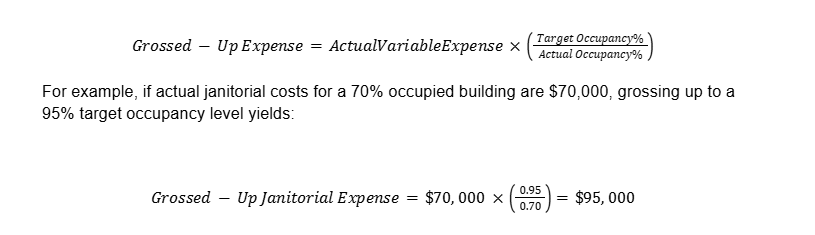
Accounting teams must carefully separate fixed expenses (such as property insurance or base real estate taxes) from variable expenses during this calculation. Fixed expenses must never be grossed up, as they do not vary with building occupancy. Variable CAM items may also include security services, including alarm monitoring, when the lease permits.

Pro-Rata Share Precision

A tenant’s pro-rata share determines their fractional responsibility for total building CAM charges, and CAM fees are typically calculated by multiplying that share by total CAM expenses. The standard calculation appears straightforward:

In this formula, the numerator is the tenant’s square footage, and the denominator is the gross leasable area or total rentable area. Some landlords also compare usable square footage to rentable area when allocating costs under the lease structure. Area maintenance CAM charges can vary based on lease type and property location even when the pro-rata method is similar. Despite its simplicity, errors frequently occur in the denominator. Landlords occasionally substitute “Occupied Square Feet” for “Total Building Rentable Square Feet” in the denominator during periods of high vacancy. This error shifts the financial burden of vacant spaces onto existing tenants, artificially inflating their pro-rata percentage and creating significant budget variance.

What Are the 3 Best Strategies to Align CAM Estimates with Actuals?

To eliminate surprise true-up liabilities and maintain steady cash flow, finance leaders and lease managers should apply three core strategies during budget preparation.

Strategy 1: Implement Dynamic Expense Tracking and Quarterly Audit Trails

Waiting for year-end reconciliation statements guarantees budget variances. Instead, adopt a quarterly audit framework to track actual landlord spend against initial monthly billing statements.

Key actions for dynamic expense tracking:

  • Request quarterly general ledger (GL) detail reports from property managers to spot cost spikes early in the fiscal cycle.
  • Compare line-item expenditures against prior-year actuals to identify trending variances in utilities, security, or seasonal maintenance, and use historical trend analysis to review how CAM costs have moved over time.
  • Establish clear accounting thresholds; flag any line item exceeding a 5% variance for immediate landlord review and clarification, and make sure projections in cam estimates also account for inflation.
  • Archive all monthly billing statements, utility invoices, and property manager notices in a central digital database for rapid year-end cross-validation.

Strategy 2: Enforce Contractual Caps and Base-Year Exclusions

Lease contracts often include protective mechanisms designed to cap expense growth and exclude non-operational costs. However, these clauses are ineffective unless actively enforced during budget season.

To enforce lease protections:

  • Audit Controllable Caps: Verify that controllable expenses (e.g., security, janitorial, administrative fees) do not exceed the agreed annual cap percentage (e.g., 5% compounded annually), since many commercial leases include audit rights and cost limitations that must be enforced actively.
  • Verify Cumulative vs. Non-Cumulative Terms: Ensure landlords do not roll over unused cap allowances from previous years unless explicit cumulative wording exists in the agreement.
  • Remove Capital Expenditures: Exclude structural repairs, roof replacements, building additions, and environmental remediation costs that landlords incorrectly include in routine maintenance categories; such items should be billed separately only if the lease expressly permits amortized recovery.
  • Validate Gross-Up Provisions: For gross leases with base-year structures, ensure property managers calculate gross-up provisions accurately based on actual building occupancy rates without grossing up fixed charges, which helps control overall occupancy costs.

Strategy 3: Standardize Vendor Bidding and Inflationary Modeling

External economic factors drive significant shifts in utility pricing, municipal property taxes, and property insurance premiums. Property managers and corporate tenants must model these uncontrollable items using realistic market data rather than static historic averages.

To standardize forecasting inputs:

  • Mandate competitive vendor bidding for major maintenance contracts (e.g., HVAC service, janitorial, landscaping, security) every 2 to 3 years.
  • Model property tax adjustments based on local municipal reassessment schedules, tax rate changes, and ongoing assessment appeals rather than generic inflation assumptions.
  • Evaluate regional property insurance rate trends, particularly for assets located in flood, hurricane, or wildfire risk zones, where premiums can spike unexpectedly.

Step-by-Step Procedure: How to Reconcile CAM Estimates in Budget Season

Follow this structured, four-step procedure during budget season to reconcile prior-year estimates, verify actuals, and set precise monthly billings for the coming year.

Step 1: Gather Master Leases, Amendments, and Reconciliation Statements

Collect all primary legal contracts, side letters, commencement date memorandums, and landlord billing statements for the target asset portfolio.

Organize key document data points:

  • Usable vs. rentable square footage metrics for both tenant space and the total building.
  • Base-year figures, expense stop thresholds, and gross-up target percentages.
  • Specific exclusions (e.g., executive salaries, leasing commissions, legal fees, advertising expenses).
  • Approved administrative and management fee percentages and cap structures.

Step 2: Extract General Ledger Line Items and Categorize Expenses

Obtain the landlord’s detailed general ledger statement for the operating year. Map every line item to its appropriate category within your lease accounting software so shared expenses tied to maintaining shared spaces are classified correctly.

Separate line items into:

  • Fixed base rent obligations.
  • Controllable CAM expenses (e.g., landscaping, interior janitorial, routine repairs, snow removal).
  • Uncontrollable CAM expenses (e.g., property taxes, building insurance, municipal water/sewer).
  • Non-recoverable landlord expenses (e.g., tenant improvement costs, legal fees for lease negotiations), while treating recoverable property management services according to the lease.

Step 3: Run Contractual Cap and Gross-Up Calculations

Apply contractual formulas to calculate the maximum allowable tenant liability for the operating period.

Work through the math step-by-step:

  1. Calculate baseline controllable expenses from the prior year or base year.
  2. Apply the contractual annual cap percentage to establish the maximum charge ceiling for the current year.
  3. Apply occupancy gross-up formulas for variable costs if building occupancy fell below full capacity during the year.
  4. To calculate CAM fees, apply the tenant’s pro-rata share to the allowable CAM pool after caps and gross-up adjustments, using verified square footage ratios and the gross leasable area identified in the lease documents as the denominator.

Step 4: Reconcile Payments and Issue Formal Audit Notices

Compare total monthly estimated payments made during the year against the calculated final liability.

Determine the net result:

  • Overpayment: Issue a formal credit request or apply the overpayment balance toward upcoming monthly rent payments as permitted by the lease.
  • Shortfall: Verify the legitimacy of the landlord’s true-up invoice before issuing final payment.
  • Formal Audit Window: If major discrepancies appear, issue a written audit notice within the contractual window (typically 30 to 90 days) to protect your rights under the lease.

In-Depth Analysis: Navigating Complex Lease Structures

Understanding how different lease structures impact CAM estimates and actual reconciliations is vital for corporate tenants managing diverse, multi-location portfolios.

1. Triple Net (NNN) Leases

In a net lease environment, tenants pay base rent plus 100% of their pro-rata share of operating expenses, property taxes, and building insurance. Because the tenant bears full operational cost exposure, accurate budgeting relies heavily on landlord transparency.

  • Key Audit Focus: Verify that capital replacements are amortized rather than expensed in full. Ensure insurance policy allocations cover only the target property, not umbrella coverage across unrelated landlord assets.
  • Budget Strategy: Request landlord operating budgets 60 days before the start of the fiscal year. Build conservative inflation buffers (5% to 8%) into tax and insurance categories.

2. Modified Gross Leases with Base Years

In base-year leases, base rent covers operating expenses up to the total cost incurred during a designated “base year” (typically the first calendar year of the lease), while a modified gross lease keeps some costs in base rent and charges others as CAM. By contrast, in double net leases tenants usually pay property taxes and insurance only, while the landlord covers other common-area costs. In subsequent years, the tenant pays only their pro-rata share of expense increases that exceed the base-year benchmark.

  • Key Audit Focus: Protect the integrity of the base-year baseline. If the base year contained artificially low expenses (due to landlord tax appeals or low occupancy), the baseline will be understated, causing artificially high pass-throughs in future years.
  • Budget Strategy: Re-evaluate base-year gross-up calculations annually. Ensure initial base-year numbers are adjusted upward if building services were expanded or occupancy increased in later years.

3. Industrial Gross and Full-Service Gross Leases

Full-service gross leases are common in many multi-tenant office building settings, where gross leases include all operating costs in a flat rental rate, including standard operating expenses, utilities, and janitorial services. However, these leases often contain expense stops or utility surcharge clauses that trigger additional billings if consumption exceeds baseline limits.

  • Key Audit Focus: Review after-hours HVAC charges, sub-metered electricity readings, and specialized janitorial additions to prevent double-billing for standard building services.
  • Budget Strategy: Install sub-meters where possible to verify actual utility consumption patterns against landlord estimates.

What Are the Most Common Pitfalls in CAM Alignment?

Avoiding common administrative mistakes ensures your finance team does not pay invalid invoices or miss critical audit deadlines.

Pitfall 1: Missing Audit Deadline Windows

Most commercial lease agreements contain strict audit limitation clauses. If a tenant fails to request backup documentation or challenge a reconciliation invoice within 30, 60, or 90 days of receipt, they forfeit their legal right to challenge those charges permanently. Always prioritize auditing incoming statements immediately upon receipt.

Pitfall 2: Accepting Unaudited Management Surcharges

Landlords routinely add a 3% to 5% administrative or property management fee on top of total operating expenses, and administrative costs should be audited alongside these surcharges. However, some landlords double-count these fees by charging both an external management company invoice and an internal administrative surcharge, which may duplicate embedded property management services already recovered elsewhere. Carefully audit management line items to eliminate duplicate charges.

Pitfall 3: Miscalculating Pro-Rata Share Ratios

A tenant’s pro-rata share depends on two metrics: tenant square footage (the numerator) and total building rentable square footage (the denominator). Landlords sometimes calculate pro-rata shares using occupied space rather than total rentable space in the denominator, inflating the tenant’s expense share. Always verify that the denominator reflects total building square footage.

Pitfall 4: Ignoring Base-Year Adjustments

In gross leases, pass-through expenses only trigger when operating costs exceed the initial base-year amount. If a landlord artificially depresses base-year expenses through deferred maintenance or one-time utility credits, future year-over-year increases will appear artificially inflated. Ensure base-year calculations accurately reflect full operational costs.

Comprehensive Troubleshooting Matrix for CAM Discrepancies

When actual CAM billings diverge significantly from annual estimates, finance and lease management teams must systematically isolate, investigate, and resolve discrepancies.

Discrepancy Type Root Cause Verification Action Resolution Mechanism
Unexplained Utility Spikes Sub-metering errors, after-hours consumption charges, or seasonal rate increases. Request interval utility meter data and daily operating schedules from property engineering. Re-bill excess consumption to specific after-hours tenants; correct faulty sub-meters.
Excessive Management Fees Admin percentage applied to excluded items (e.g., real estate taxes or capital projects). Recalculate administrative fee base after stripping out taxes, insurance, and CapEx. Issue credit memo removing admin fees assessed on non-controllable or excluded expenses.
Cap Overrun Discrepancies Landlords applied a simple annual cap instead of a cumulative cap, or ignored the cap entirely. Cross-reference baseline controllable charges against master lease cap terms. Recalculate controllable charges using contractual cap ceiling; adjust total invoice balance.
Tax Reassessment Shortfalls Landlords failed to budget for municipal property tax increases following building sale or renovation. Review local county tax assessor records and property tax appeal documentation. Negotiate structured payment terms for retroactive tax billings; update baseline for upcoming year.
Square Footage Mismatches Building expansion or re-measurement altered the rentable area without updating tenant lease addendums. Audit architect floor plans, BOMA measurement standards, and official lease amendments. Adjust pro-rata percentage in lease sub-ledger; apply retroactive credit for overpayments.

Frequently Asked Questions (FAQ)

What is the difference between a gross lease with a base year and a triple net (NNN) lease?

In a triple net (NNN) lease, the tenant pays their pro-rata share of all operating costs, property taxes, and building insurance from day one. In a gross lease with a base year, the landlord pays operating costs up to the initial base-year amount, and the tenant only pays for expense increases that exceed that initial baseline in subsequent years.

How do cumulative and non-cumulative CAM caps differ?

A non-cumulative cap limits controllable expense increases to a set percentage each year (e.g., 5% maximum annual increase). A cumulative cap allows unused cap capacity from previous low-cost years to roll forward, enabling the landlord to charge higher cost increases in future years provided the overall multi-year average remains within the capped rate.

Can a tenant withhold rent while auditing CAM reconciliation statements?

In almost all commercial lease agreements, withholding rent is a material lease breach, regardless of active CAM disputes. Tenants should pay disputed charges under formal written protest, clearly stating that payment does not waive their contractual audit rights or claim remedies.

What happens if a landlord refuses to provide general ledger backup for CAM actuals?

If a landlord refuses backup documentation within the contractual review window, issue a formal written notice of default citing the audit provisions in your lease agreement. Most commercial leases legally require landlords to provide supporting invoices, tax bills, and general ledger reports upon reasonable written request.

How can outsourcing CAM reviews simplify budget season?

Reviewing complex legal contracts and detailed accounting ledgers requires specialized skill sets and substantial administrative time, and outsourced reviews help both the property owner and tenant understand CAM fees that vary by lease type and property location. Partnering with professional lease abstractors and auditors at Re BackOffice streamlines the review process, ensures strict enforcement of lease caps, and identifies hidden overcharges before budgets are finalized.

Final Thoughts: Master Your CAM Budget Alignment Today

Aligning CAM estimates with actual operating expenses during the annual budget season is essential for maintaining accurate financial forecasts and protecting operational profitability. By deploying continuous quarterly expense tracking, enforcing lease caps, and completing rigorous year-end audits, real estate professionals can eliminate budget volatility and ensure complete contract compliance.

CAM estimates are primarily a commercial real estate concern, since CAM charges generally do not apply to purely residential leases.

Don’t let unverified landlord reconciliations and overlooked billing errors drain your operating funds. Partnering with an expert lease administration company like Re BackOffice delivers the accuracy, audit depth, and portfolio transparency needed to navigate budget season with total confidence.

Rebo-contact-us

About the Author

Rukmani Anantharaman
Marketing Director at RE BackOffice

Rukmani Anantharaman is the Marketing Director at RE BackOffice, specializing in building awareness and thought leadership around lease administration, lease abstraction, and CAM reconciliation. She creates insightful, industry-focused content that helps CRE firms, retailers, corporates, and REITs better understand, streamline, and optimize their lease operations for improved accuracy and cost efficiency.

LinkedIn

RE BackOffice Sets a New Benchmark for Excellence with an NPS Score of 83

RE BackOffice Achieves an NPS Score of 83: Setting the Standard for Excellence

RE BackOffice is proud to have achieved an exceptional Net Promoter Score (NPS) of 83, placing us firmly in the category of world-class service providers. 

Our score of 83, on a scale ranging from -100 to +100, highlights our dedication to delivering unparalleled services in lease administration, abstraction, and CAM reconciliation. This achievement positions us significantly above industry benchmarks, showcasing the strength of our client relationships and our commitment to exceeding expectations

What is NPS and Why Does It Matter?

Net Promoter Score (NPS) is a metric used by businesses worldwide to measure customer satisfaction and loyalty. Developed by Fred Reichheld in 2003, NPS has become the gold standard for understanding how customers feel about a company.

The metric is based on one simple yet insightful question:
“How likely are you to recommend our services to a friend or colleague?”

Customers respond by giving a score from 0 to 10, and based on their responses, they are classified into three categories:

  • Promoters (9–10): Loyal and enthusiastic customers who actively recommend your business.
  • Passives (7–8): Satisfied but not thrilled customers who are neutral and less likely to promote your services.
  • Detractors (0–6): Dissatisfied customers who may share negative feedback and discourage others from engaging with your business.

Once categorized, the NPS is calculated using the following formula:

NPS=% of Promoters−% of DetractorsNPS = \% \text{ of Promoters} – \% \text{ of Detractors}NPS=% of Promoters−% of Detractors

This results in a score ranging from -100 to +100:

  • +100: The ideal score, achieved when every customer is a Promoter.
  • -100: The lowest possible score, meaning every customer is a Detractor.

Our NPS score of 83 demonstrates an exceptional level of customer satisfaction and loyalty. This means the overwhelming majority of our customers are Promoters actively recommending our services to others.

Why NPS is a Game-Changer for Businesses

NPS is not just another customer feedback tool; it’s a strategic asset for businesses. Here’s why it’s critical:

  1. Measures Customer Loyalty: NPS provides a clear snapshot of how loyal your customers are. It goes beyond satisfaction by identifying the true advocates of your brand your Promoters and highlighting areas where you can improve for Detractors.
  2. Fuels Organic Growth: Promoters are more than just loyal customers they’re brand ambassadors. Their recommendations lead to higher-quality referrals, fueling growth through trust and word-of-mouth.
  3. Enables Benchmarking: NPS allows you to compare your performance against industry standards. A score like ours, 83, sets us apart as a leader in our field and showcases our dedication to excellence.
  4. Drives Continuous Improvement: By analyzing NPS data over time, businesses can identify trends, address weaknesses, and refine their offerings to better meet customer expectations.
  5. Our Commitment to Exceptional Service: Our high NPS score reflects our unwavering dedication to delivering services that exceed expectations. But we don’t stop at the numbers. We actively use NPS insights to ensure every client feels heard, valued, and supported.

How We Maintain a High NPS

Our exceptional NPS score isn’t by chance. It’s the result of deliberate efforts in the following key areas:

    1. Personalized Solutions:
      Every client has unique needs, and we tailor our services to meet them whether it’s lease administration, lease abstraction or CAM reconciliation.
    2. Proactive Communication:
      We believe in transparency and keeping our clients informed every step of the way. Feedback is always welcomed, and we address concerns promptly.
    3. Relentless Improvement:
      We don’t rest on our laurels. NPS feedback is our guide for continuous improvement, ensuring we stay ahead of client expectations.
    4. Leveraging AI for Scalability and Efficiency: AI helps us scale quickly, meet tight deadlines, and manage large volumes of data while ensuring accuracy. This technology allows us to deliver efficient, timely services to our clients.
    5. A Strong Focus on Quality – Human and Technological: While AI enhances efficiency, our human quality control processes ensure that every task meets our high standards. This balance between technology and expertise guarantees top-tier results.
    6. Experienced Team with Over 10 Years of Collective Expertise: With an average of over 10 years of experience, our team brings deep industry knowledge to every project. This expertise enables us to exceed client expectations.

Breaking Down Our NPS Score of 83

Let’s take a closer look at what our score of 83 means in practical terms:

  • Promoters: These customers are highly likely to recommend our services. They are the driving force behind our exceptional score.
  • Passives: While satisfied, these customers might not be as enthusiastic as Promoters. We actively work to convert Passives into Promoters by addressing their needs.
  • Detractors: With such a high NPS, our percentage of Detractors is minimal. However, we take every piece of feedback seriously and strive to resolve concerns quickly.

Achieving such a high score on the -100 to +100 scale is a testament to our commitment to customer satisfaction. It shows that our customers not only trust us but are also willing to recommend us to others.

What Our Clients Are Saying

The true measure of our success lies in the words of our clients. Here are some testimonials from our recent NPS survey:

  • “It was a pleasure working with RE BackOffice. I was very happy with the abstraction work. I appreciate the thoughtful questions that were asked during the project and excellent communication.” (A leading American Telecommunications Service Provider)
  • “Have been using RE BackOffice for our lease abstraction for about 14 years.  They are always quick to respond, accurate and very friendly. ” – (A leading American convenience store chain)
  • “We are very pleased with both of our dedicated lease administration resources at RE BackOffice. They are both very responsive and professional and are a great addition to our team!.” – (A leading American Property Management Company)
  • “I have been extremely satisfied with our dedicated lease administration resource at RE BackOffice. Their prompt attention to detail, consistent and weekly check-ins to ensure that any questions or inquiries are addressed in a timely manner with the clients that we work together on. Great communication is the focal point for success in addition to expansion of services and I hope that we can continue to grow!” (A leading American Property Management Company)

These testimonials reflect the trust and loyalty of our customers, and they drive us to continually raise the bar.

How We Use NPS to Improve

At RE BackOffice, NPS is more than just a number it’s a tool for growth and improvement. Here’s how we leverage it:

  1. Listening to Feedback: We analyze every response carefully. Promoters help us understand what we’re doing right, while Detractors provide invaluable insights for improvement.
  2. Identifying Trends: By examining NPS trends over time, we stay ahead of customer expectations and adapt to changing needs.
  3. Taking Action: Feedback drives action. We’re committed to resolving issues for Detractors, nurturing Passives into Promoters, and maintaining the trust of our most loyal customers.
  4. Celebrating Successes: Our high NPS score is a team effort. Internally, we celebrate these wins, recognizing the hard work of our employees in delivering excellence.
  5. Why Choose Us?

Our NPS score of 83 is more than just a number it’s proof of our commitment to delivering outstanding service. Reach out to RE BackOffice if you are-

  • Seeking assistance with lease abstraction and ongoing administration.
  • Need support with CAM reconciliation, recovery audits, or lease audits, with tight deadlines or limited resources.
  • Facing a shortage of lease administration resources and an overwhelming workload.
  • Aiming to improve operational efficiency and reduce costs without sacrificing quality.

Whether you’re looking for lease administration, lease abstraction, or CAM Reconciliation, we’re here to deliver with excellence.

A Commitment to Excellence

At RE BackOffice, customer satisfaction isn’t just a priority it’s our mission. Our exceptional NPS score reflects the trust and loyalty of our clients, and we’re dedicated to maintaining and exceeding these standards.

RE BackOffice Inc. (REBO) is a global boutique firm specializing in real estate marketing and lease services. Our Lease Services Group (REBOlease.com) provides Lease Administration, Lease Abstraction, CAM Reconciliation and Recovery Audit services to clients across diverse industries, covering every type of lease on any lease administration platform. Since 2006, we have diligently served over 1000 clients giving us the experience needed to be a trusted partner. Whether we are utilizing this comprehensive expertise or harnessing the power of our proprietary lease abstraction software, we bring an unparalleled strategic and financial advantage to our clients.

If you’re ready to work with a team that puts your needs first, Contact Us Today. Let us show you why so many customers are promoters of our business.

RE BackOffice